
One Swab, Multiple Answers: How the Shift to Multiplex Testing Is Reshaping Nasal Swab Demand

For most of the last decade, a nasal swab was a nasal swab. You collected a sample, ran one test, got one answer. That’s changing — and the shift has real implications for anyone sourcing sampling consumables.
What’s driving the change
Respiratory illness seasons have always involved more than one virus. What changed after COVID is that clinicians, labs, and patients all got used to nasal swab testing at a scale that didn’t exist before. Now the question isn’t just “do you have COVID?” — it’s “do you have COVID, flu A, flu B, or RSV?” And ideally, you want that answer from a single sample collected once.
Major diagnostic platforms have moved in this direction fast. Abbott’s Alinity m Resp-4-Plex and Cepheid’s Xpert Xpress CoV-2/Flu/RSV are designed specifically around the “one swab, one result for four pathogens” model. The clinical logic is straightforward: flu A, flu B, COVID-19, and RSV produce overlapping symptoms, require different treatments, and can co-infect the same patient. Running separate tests wastes time and costs more. Running one multiplex assay from a single anterior nasal swab is faster and cheaper — provided the swab delivers adequate sample volume.
That last part is where the swab itself starts to matter more.
Why multiplex testing puts more pressure on swab quality
A single-pathogen rapid antigen test is relatively forgiving. You need enough viral material to cross a detection threshold, and that threshold is often set conservatively. Multiplex PCR assays are more sensitive — but they’re also more demanding in terms of sample consistency. If the swab doesn’t release the specimen cleanly into the transport medium, or if the tip geometry doesn’t collect efficiently from the anterior nasal cavity, you start seeing false negatives that aren’t failures of the assay — they’re failures of the collection step.
Research published in peer-reviewed literature has confirmed what labs have known practically for a while: sample quality and collection technique are critical variables in rapid diagnostic test reliability, often more so than the test platform itself. A lab running a high-end multiplex assay with a mediocre swab is not getting the performance that assay is capable of delivering.
This is one reason flocked swabs have continued to gain share even as COVID-specific demand has normalized. The brush-like tip surface of a flocked swab keeps the specimen near the surface rather than absorbing it deep into fiber, which means more of the collected material transfers into the elution medium. For PCR-based multiplex panels, that difference is measurable.
What this means for procurement
If you’re sourcing nasal swabs for a diagnostic kit that will be validated against a multiplex platform, the swab isn’t a commodity decision anymore. It’s part of your product’s performance specification.
A few things that follow from this:
Swab-assay co-validation is increasingly common. Diagnostic kit manufacturers run their own validation studies pairing specific swab lots with their assay to establish baseline sensitivity and specificity. This means swab consistency across production batches matters — not just the average performance, but the variation.
Tip geometry is application-specific. Anterior nasal swabs used for self-collection are designed differently from nasopharyngeal swabs used by clinicians. If your kit targets self-collection — which is where a growing portion of at-home and decentralized testing sits — the swab needs to be validated in that specific use case.
OEM flexibility becomes a real requirement. Kit manufacturers often need swabs packaged in specific configurations — with or without transport tubes, with branded labeling, in particular peel-pouch formats. The ability to customize without a disruptive MOQ is something worth confirming early with any supplier.
The market context
The nasal swab market was valued at approximately USD 1.2 billion in 2024 and is projected to reach USD 2.5 billion by 2033. The growth story post-COVID isn’t about COVID specifically — it’s about the infrastructure for respiratory pathogen surveillance that COVID built, and the multiplex assay market that’s growing on top of it.
Seasonal flu, RSV, and the ongoing co-circulation of respiratory viruses mean that swab demand is no longer tied to a single outbreak event. It’s becoming a recurring, year-round procurement item for labs, clinics, and at-home test kit distributors.
How Changfeng Medical fits into this
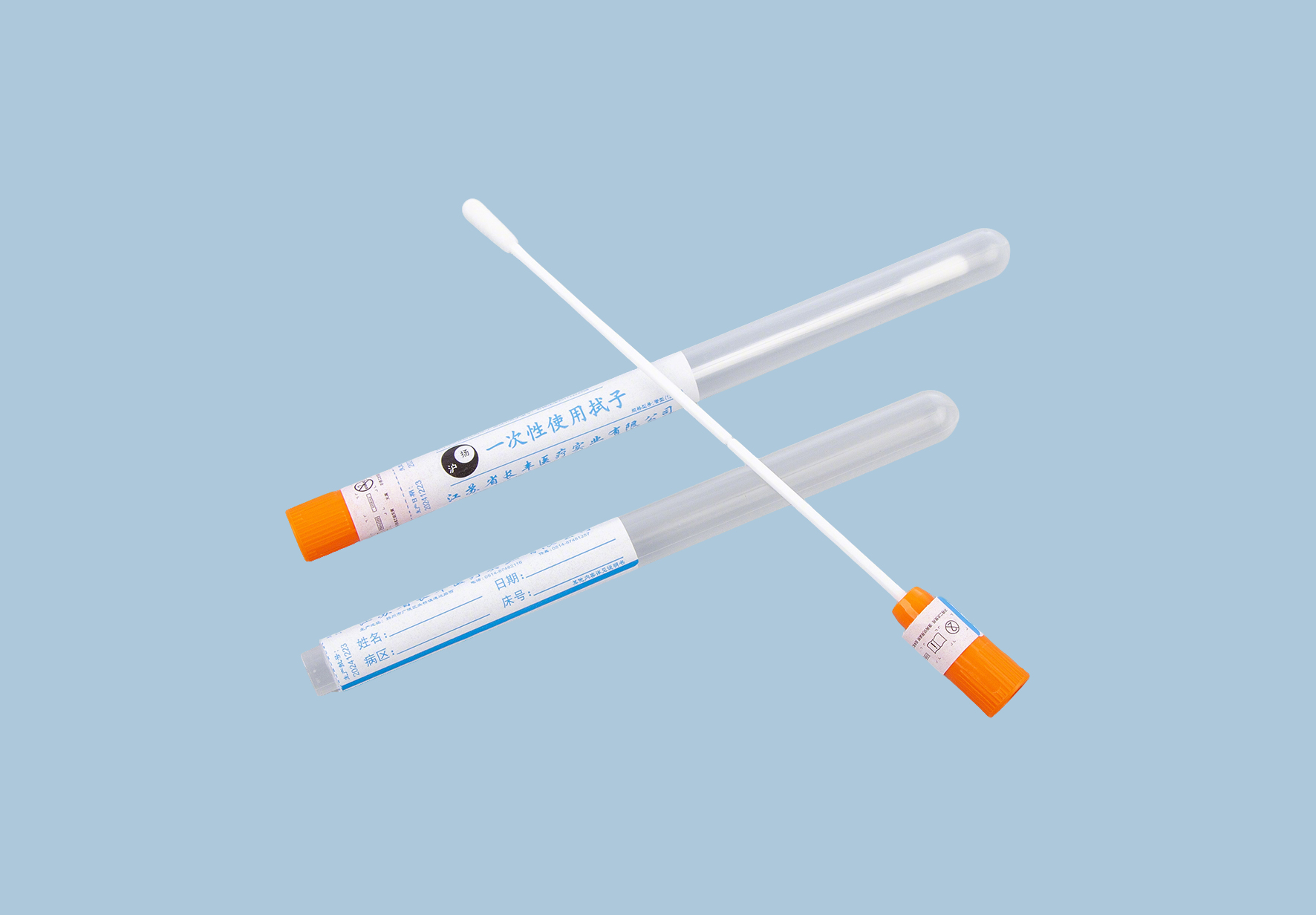
Changfeng Medical produces flocked nasal swabs (Model SZ001) designed for anterior nasal collection — the format compatible with self-collected multiplex assay kits and point-of-care testing. Manufactured under ISO 13485 with CE MDR and MDSAP certification, each swab is individually packaged and EO sterilized.
For kit manufacturers and distributors evaluating suppliers for multiplex-compatible swabs, Changfeng Medical offers OEM customization on labeling, packaging configuration, and shaft breakpoint spec — with the documentation to support regulatory submissions in EU and other markets.
If you’re building a product specification or qualifying a new swab supplier, sample lots are available on request.
Get in touch with Changfeng Medical →
Related: Double-tip Throat Swab · Large-headed Flocked Swab · Polyester Fiber Swab with Sheath