
The Rise of Self-Collection: Why At-Home Nasal Swab Testing Is Becoming a Mainstream Supply Chain Category

Not long ago, getting a nasal swab done meant going somewhere — a clinic, a testing center, a hospital. A trained healthcare worker inserted the swab, labeled the sample, and sent it off. That model still exists, but it’s no longer the only one, or even the dominant one in some markets.
The at-home nasal swab test kit market was valued at USD 1.2 billion in 2024 and is projected to reach USD 3.5 billion by 2033 — a CAGR of around 12.5%. That’s not post-COVID hangover demand. It’s a structural shift in how diagnostic testing gets done, and it has real implications for anyone sourcing swabs.
What changed, and why it stuck
COVID-19 didn’t invent at-home testing, but it scaled it fast enough to normalize it. The FDA authorized over 200 million home test kits for emergency use in the US alone. Amazon started delivering anterior nasal swab kits to people’s doors. Regulatory agencies in Canada, the EU, and across Asia-Pacific fast-tracked authorizations for self-collection formats.
What made this work clinically — and what surprised some skeptics — is that anterior nasal self-collection turned out to be diagnostically reliable. Research published in peer-reviewed journals found no meaningful difference in test adequacy between samples collected by trained healthcare workers and those collected by patients themselves at home. The anterior nasal cavity is accessible enough that most people, given clear instructions, can collect a usable sample.
That finding removed the main clinical objection to at-home testing. What’s left is a format that’s cheaper, faster, and more scalable than clinic-based collection — and those advantages don’t go away when a pandemic ends.
The swab design problem that at-home testing creates
Here’s the issue: a swab designed for a trained clinician isn’t automatically the right swab for self-collection.
When a healthcare worker collects a sample, they know how far to insert the swab, how much pressure to apply, and how long to hold it in contact with the nasal mucosa. A patient doing this for the first time at home doesn’t. So the swab has to compensate. The tip needs to be soft enough that mild over-insertion doesn’t cause pain that makes the user stop too early. The shaft needs to be flexible enough to handle slight deviations in angle without breaking. And the collection zone needs to be forgiving — able to pick up an adequate sample even if the insertion isn’t perfectly positioned.
This is a different engineering brief than a clinician-use swab. Manufacturers who treat them as interchangeable are leaving test sensitivity on the table.
The other design factor is the breakpoint. In a clinical setting, a swab with an imprecise break is an inconvenience. In an at-home kit, it’s a potential sample contamination event that the user has no way to recover from. Clean, consistent shaft breakpoints are a quality specification that matters differently in the self-collection context.
What this means for kit manufacturers and distributors
If you’re building or distributing a diagnostic kit targeting the self-collection market, the swab selection process is different from a hospital supply procurement:
Validation against your specific assay matters more. Self-collected samples have more variability in collection technique than clinician-collected samples. Your kit’s claimed sensitivity should be validated using swabs that are actually in your kit — not a reference swab from the assay developer’s own materials.
User instructions are part of the product. The swab design should inform how you write the collection guide. If the swab tip has specific insertion depth requirements, that needs to be communicated clearly. Some swab designs have visual depth indicators or stop features that simplify this.
Regulatory pathways are still evolving. Self-collection authorization requirements vary significantly by market. The EU’s IVDR framework treats intended use — including who collects the sample — as a core part of the regulatory submission. If you’re planning to sell in multiple markets, your swab supplier needs to be able to provide the documentation that supports self-collection claims in each jurisdiction.
Where Changfeng Medical sits in this
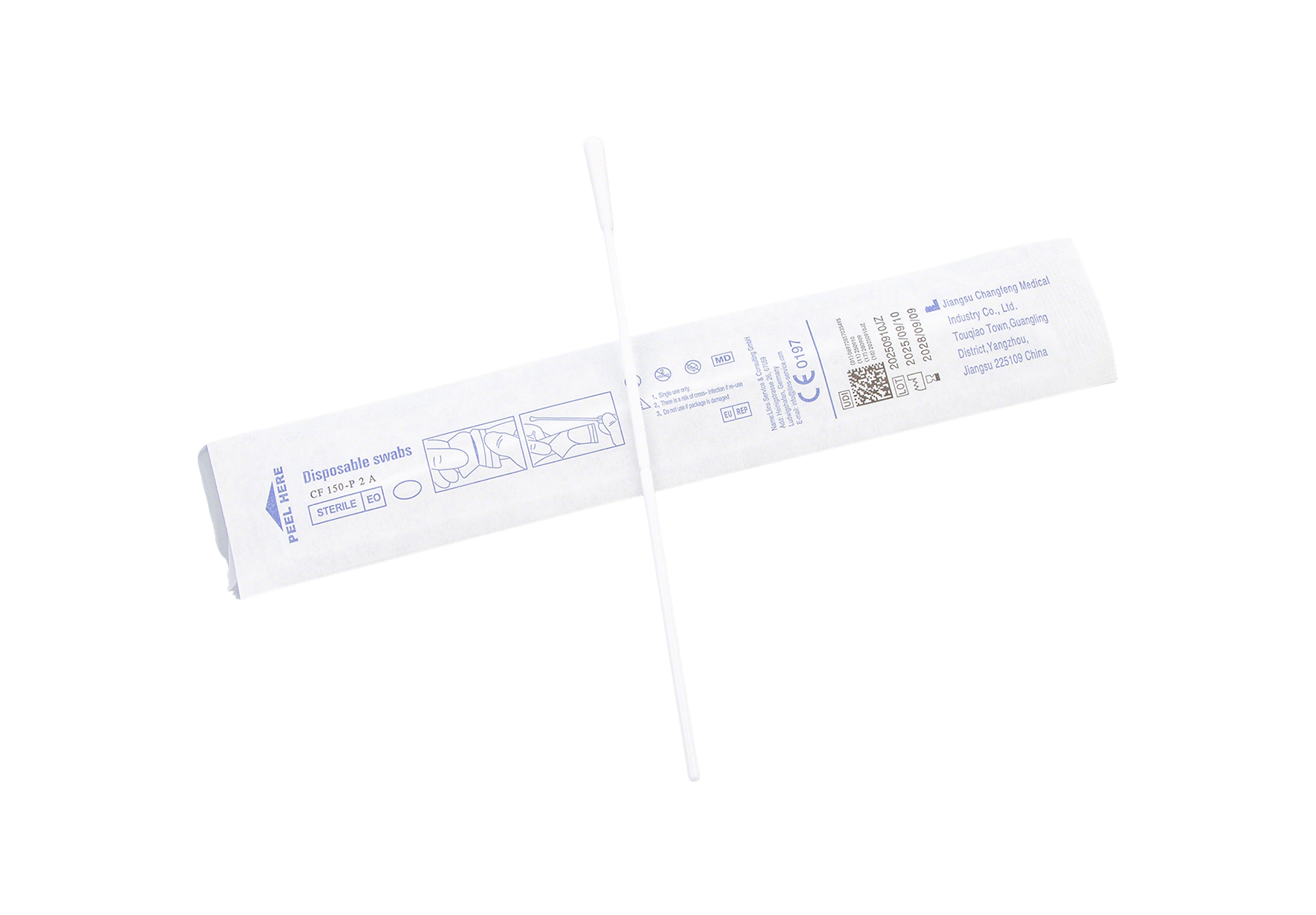
Changfeng Medical’s flocked nasal swab (Model SZ001) is designed around anterior nasal collection — the format validated for self-collection use. The soft flocked tip, flexible shaft, and consistent breakpoint make it suitable for kit configurations targeting at-home and point-of-care use.
For distributors and kit manufacturers, Changfeng Medical offers OEM customization on packaging, labeling, and product configuration, with ISO 13485, CE MDR, and MDSAP certification backing the supply. If you’re qualifying swabs for a self-collection product line, sample lots and technical documentation are available on request.
Contact Changfeng Medical for samples and pricing →
Related products: Double-tip Throat Swab · Large-headed Flocked Swab · Polyester Fiber Swab with Sheath