
Vacuum Retention and Shelf Life in Blood Collection Tubes: Managing the Cold Chain and Stock Rotation Risk

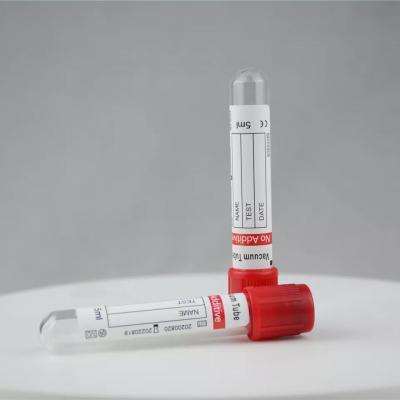
A blood collection tube’s vacuum is not a static property locked in at the moment of manufacture. It is a draw of negative pressure sealed behind a rubber stopper, and like any sealed vacuum, it degrades over time at a rate that depends on stopper material, seal quality, and storage conditions. For distributors managing inventory and OEM buyers setting shelf-life claims on finished kits, understanding how vacuum retention actually decays — and what that means for stock rotation — prevents a category of customer complaint that often gets misdiagnosed as a manufacturing defect when it is actually a storage or rotation issue.
What Vacuum Decay Actually Looks Like
Every vacuum tube loses some negative pressure over its shelf life, even under ideal storage conditions, because no rubber stopper seal is perfectly impermeable to gas diffusion. Manufacturers set an expiration date based on the point at which vacuum decay would reduce draw volume below an acceptable tolerance — typically defined as the point where fill volume drops outside a percentage band of the labeled draw volume. A tube approaching the end of its shelf life will still draw blood, but it may draw less than the labeled volume, which matters most for additive-ratio-sensitive tests like coagulation studies where under-filling changes the result rather than just producing a smaller sample.
This is a gradual process under normal conditions, which is why properly stored tubes carry shelf lives in the range of one to two years from the date of manufacture. The decay curve is not linear, however, and it accelerates sharply when storage conditions deviate from what the manufacturer validated — which is the mechanism behind most of the field complaints distributors actually see.
Temperature Exposure During Transit
Rubber stopper materials — typically butyl or chlorobutyl formulations chosen specifically for low gas permeability — become more permeable to gas exchange as temperature rises. A shipment that sits in an uncontrolled cargo hold or a customs warehouse at elevated ambient temperature for an extended period can lose vacuum at a meaningfully faster rate than the same tubes stored under the manufacturer’s validated conditions, even if the total elapsed time is well within the printed expiration date.
This is the scenario distributors should screen for when a customer reports under-filled tubes from a shipment that is nowhere near its expiration date. The tubes were very likely within specification when they left the manufacturing facility; the question is what happened to them during transit and customs clearance, particularly on routes that involve extended dwell time in non-climate-controlled storage. Distributors sourcing internationally should ask manufacturers directly what temperature range their shelf-life validation covers, and should treat that range as a hard constraint on freight and warehousing decisions rather than a theoretical specification.
First-In-First-Out Discipline and Why It Matters More Than It Seems
Because vacuum decay is cumulative and partly irreversible, stock rotation discipline has a direct effect on the performance customers experience even when every tube in inventory is technically within its expiration window. A distributor holding multiple manufacturing lots in the same warehouse needs FIFO discipline not just as a general inventory best practice but specifically because the oldest lot in stock has the least vacuum margin remaining — and shipping that lot to a customer who then experiences further transit delay compounds a decay process that was already further along than fresher stock would have been.
This argues for lot-level tracking rather than SKU-level tracking in distributor inventory systems. Knowing that a given customer received tubes from a lot manufactured fourteen months ago, rather than simply knowing the SKU shipped, is what allows a distributor to diagnose a fill-volume complaint quickly and correctly rather than defaulting to a manufacturing-defect assumption that may not be accurate.
Setting Shelf-Life Claims for Private-Label Kits
OEM buyers assembling kits that include blood collection tubes as a component face an additional layer of complexity: the kit’s overall shelf-life claim cannot exceed the shortest-lived component, and a tube’s validated shelf life under the kit’s actual storage and distribution conditions is what should drive that claim — not the manufacturer’s headline shelf-life figure, which is typically validated under controlled laboratory storage conditions that may not match the kit’s real-world distribution environment.
Buyers should request the manufacturer’s actual stability study conditions — temperature range, humidity range, and the specific vacuum-retention or fill-volume tolerance used as the study’s pass criterion — rather than accepting a shelf-life number without that context. A eighteen-month shelf life validated at controlled room temperature is a different commitment than an eighteen-month shelf life validated across a wider temperature excursion range that better reflects actual freight conditions, and kits distributed through longer or less climate-controlled supply chains should be specified against the latter.
What This Means for Quality Agreements
A supply agreement that addresses vacuum retention only at the point of manufacture is missing the part of the lifecycle where most real-world failures originate. Buyers negotiating quality agreements with tube suppliers should specifically include incoming inspection rights for vacuum or fill-volume verification on receipt, particularly for shipments arriving after extended transit, and should clarify whether a fill-volume failure discovered at receipt — as opposed to at the point of use — falls under warranty if storage and transit conditions can be documented as within validated range.
Changfeng Medical validates vacuum retention and fill-volume stability across the shelf life of its blood collection tube lines and can provide stability study documentation to support OEM shelf-life claims and distributor quality agreements. Reach out through our contact page or browse current specifications on our IVD diagnostic consumables page.