
Nylon Flocked, Polyester, or Foam: How Swab Tip Material Affects Sample Recovery in IVD Applications

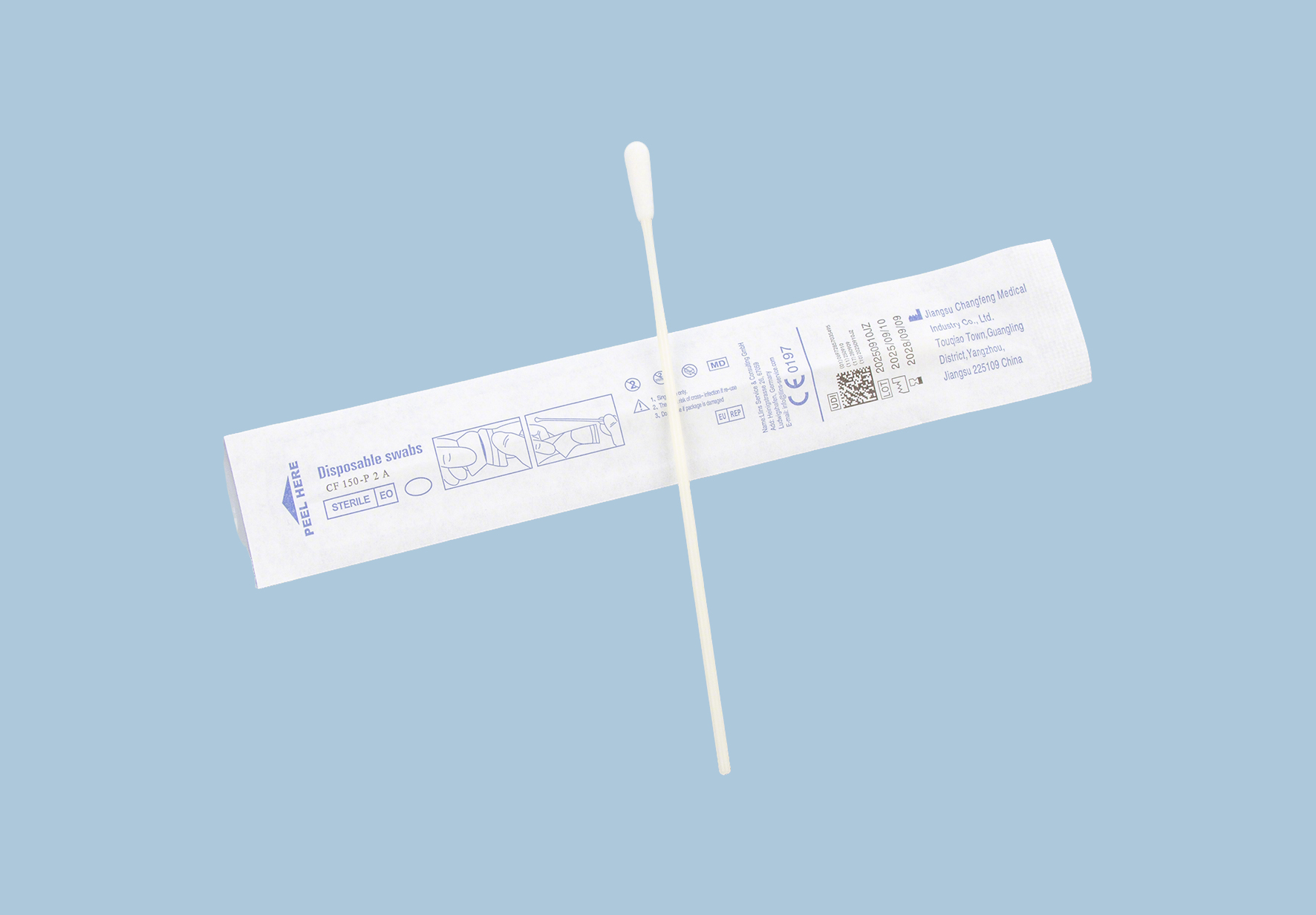
Swab tip material is one of the most consequential choices in IVD kit design, and one of the least discussed. When kit developers or procurement teams evaluate sampling swabs, the conversation usually starts with shaft dimensions, breakpoint position, and unit price. The tip fiber type gets a line on the spec sheet and not much more.
That’s worth reconsidering. The tip material determines how efficiently a swab collects biological material from a mucosa surface, how well it holds the sample during transport, and — critically — how completely it releases the sample into the downstream buffer or transport medium. Each of those steps affects assay sensitivity. A swab that collects well but elutes poorly contributes to false negatives just as surely as one that collects poorly from the start.
The Three Materials in Common Use
Most clinical and IVD sampling swabs use one of three tip constructions: nylon flocked fiber, spun polyester, or open-cell foam. Each behaves differently across collection, retention, and elution — the three phases that matter.
Nylon Flocked Fiber
Flocked swabs are manufactured by electrostatically depositing cut nylon fibers perpendicular to an adhesive-coated tip. The result is a brush-like surface structure with no internal core — all of the absorbed material sits near the surface, where it can be released rapidly on contact with liquid medium.
This architecture gives flocked swabs two properties that matter in molecular and antigen testing. First, sample uptake is fast and driven by capillary action through the fiber matrix. Second, elution is efficient — validated data shows flocked tips releasing more than 90% of absorbed specimen into transport medium, compared to substantially lower figures for traditional wound-fiber swabs. For PCR-based assays where viral load quantification matters, that elution efficiency translates directly to assay sensitivity.
The tradeoff is that nylon has a degree of nucleic acid affinity through hydrogen bonding between the N-H groups in polyamide and the phosphate backbone of DNA and RNA. In most diagnostic applications this binding is transient and disrupted by elution buffers, but it is worth confirming compatibility when working with specific extraction chemistries — particularly low-ionic-strength buffers where binding may be more persistent.
Nylon flocked swabs are the default choice for nasopharyngeal, nasal, and throat collection in molecular respiratory testing. They are also widely used in cervical, wound, and urogenital sampling where PCR sensitivity is the priority.
Spun Polyester
Polyester swab tips are constructed by winding or wrapping polyester fiber around a shaft tip to form a compact, slightly absorbent pad. Unlike cotton or rayon, polyester is hydrophobic at the fiber level — it does not bind nucleic acids through ionic interactions, which makes it a cleaner choice for molecular applications than older wound-fiber materials.
The practical advantage of polyester is its versatility. It performs reliably across a wide range of collection sites and is compatible with standard viral transport media, liquid Amies medium, and most IVD buffers. Collection efficiency is lower than flocked nylon for deeply penetrating samples (nasopharyngeal), but for anterior nasal, throat, and wound collection — sites where the swab contact area is accessible — the difference is smaller and sometimes within assay tolerance.
Polyester is also more forgiving in kit configurations where the tip remains dry for extended storage before use. The fiber structure is stable, does not shed fragments easily, and maintains its form under typical handling conditions. For kit developers building products targeting lower-complexity settings or lower-cost configurations, polyester offers a practical cost-performance tradeoff that flocked nylon doesn’t always justify.
Open-Cell Foam
Foam swab tips are made from polyurethane or similar open-cell materials. The open structure creates significant surface area and reasonable absorption capacity, but the retention and elution profile is different from both flocked and polyester options. Foam tends to hold sample material within the cell matrix, which can reduce elution yield unless the tip is physically compressed against the tube wall during processing.
Foam performs best in applications where sample volume is generous and elution is facilitated by tube geometry — collection of saliva or buccal cells being the clearest examples. In respiratory antigen testing, foam mini-tip designs have been validated for anterior nasal collection and are used in a number of rapid antigen platforms, particularly those targeting point-of-care or self-test configurations where a softer, less intimidating tip improves user compliance. BD’s 2025 launch of a flocked foam swab optimized for rapid antigen testing without refrigeration reflects active development in this space for low-resource and remote settings.
Foam is generally not the right choice for nasopharyngeal or deep-sampling applications, where the tip geometry and fiber structure of flocked nylon is better suited to the anatomy and sample requirements.
Matching Material to Application
For kit developers and procurement managers, the decision framework is straightforward once the application is clearly defined:
PCR and molecular assays, upper respiratory collection: Nylon flocked is the standard. Elution efficiency and sample yield are critical, and the performance gap over polyester and foam is meaningful.
Antigen rapid tests, anterior nasal or throat collection: Either nylon flocked or polyester works well, with flocked giving a modest advantage in sample yield. Foam is validated in some antigen platforms and appropriate where patient comfort and self-collection usability are the primary design constraints.
Culture-based bacteriology, wound or urogenital collection: Polyester or flocked nylon both perform well. The key is confirming compatibility with the transport medium — both work with Amies and Stuart media; cotton and rayon, which are still found in some older catalog offerings, should be avoided in molecular applications due to PCR inhibition risk.
Buccal, saliva, or cell scraping applications: Foam or flocked, depending on the downstream assay. Foam gives higher cell volume in buccal collection; flocked gives better elution into liquid medium. Neither is universally better — the right answer depends on extraction protocol.
What Suppliers Should Document
When qualifying a swab supplier, the tip material specification should come with supporting documentation beyond the fiber type label. Ask for elution efficiency data — percentage of absorbed sample released into the specified transport medium under the specified conditions. Ask for compatibility data with the transport media or buffers your kit uses. And ask for nucleic acid inhibition data if the swabs will be used upstream of PCR; some fiber types and adhesive systems introduce inhibitors that affect amplification.
The combination of tip material, shaft design, and downstream medium compatibility is what determines functional performance — not any single variable in isolation. Suppliers who can produce validation data across all three are the ones worth building a qualification process around.
Changfeng Medical produces sampling swabs across nylon flocked and polyester tip configurations, including nasal swabs, large-headed flocked swabs, and polyester fiber swabs with sheath, manufactured under ISO 13485 with CE and MDSAP coverage. Sample units and technical documentation available on request for OEM and kit qualification purposes.