
The Compliance Problem in Colorectal Cancer Screening — and What the Collection Bottle Has to Do With It

The data on colorectal cancer screening is unambiguous. Catch it early, and survival rates are high. Miss it, and outcomes deteriorate sharply. The global market for fecal occult blood testing is projected to grow from USD 3.5 billion in 2024 to USD 6.5 billion by 2033 — a reflection of governments and health systems investing seriously in population-level screening.
And yet the programs are consistently undermined by one stubborn problem: patients don’t complete the test.
Why compliance is the central challenge
FOB testing is, on paper, one of the most convenient cancer screening tools available. No clinic visit, no invasive procedure, no preparation. Patients collect a stool sample at home and mail it back. The US Preventive Services Task Force recommends annual FIT testing for all average-risk adults aged 45 to 75. In the UK, NHS sends kits to millions of people every year.
But return rates tell a different story. Depending on the country and program design, anywhere from 30% to 60% of people who receive a home FOB kit never send it back. Some of this is about awareness. Some is about cultural attitudes toward discussing bowel health. But a significant portion comes down to the kit itself — specifically, whether the collection experience is clear, clean, and simple enough that a non-medical person will actually complete it without giving up.
This is where the design of the FOB bottle becomes a patient experience issue, not just a technical one.
What makes a collection bottle easy — or not — to use
Most people who receive an FOB kit have never used one before and won’t have a healthcare professional there to guide them. The instructions in the box are all they have. If anything about the collection step is confusing, uncomfortable, or uncertain, the kit goes in a drawer and doesn’t come back.
A few design factors make a meaningful difference:
Cap ergonomics. The screw cap needs to feel secure when closed. If a patient isn’t sure whether they’ve sealed it properly — because the cap feels loose, or there’s no tactile feedback at the close point — they may either repeat the step incorrectly or abandon the kit entirely out of concern about leakage. A well-designed cap closes with a definite stop, requires minimal force, and stays sealed without effort.
Probe visibility and intuitiveness. The sampling probe attached to the cap needs to be visually obvious and easy to use without instruction. If the patient has to study a diagram to figure out which part of the cap to unscrew, or how to insert the probe into the sample, the drop-off risk increases. Clear color distinction between the probe and cap body, and an obvious unscrewing direction, reduce this friction.
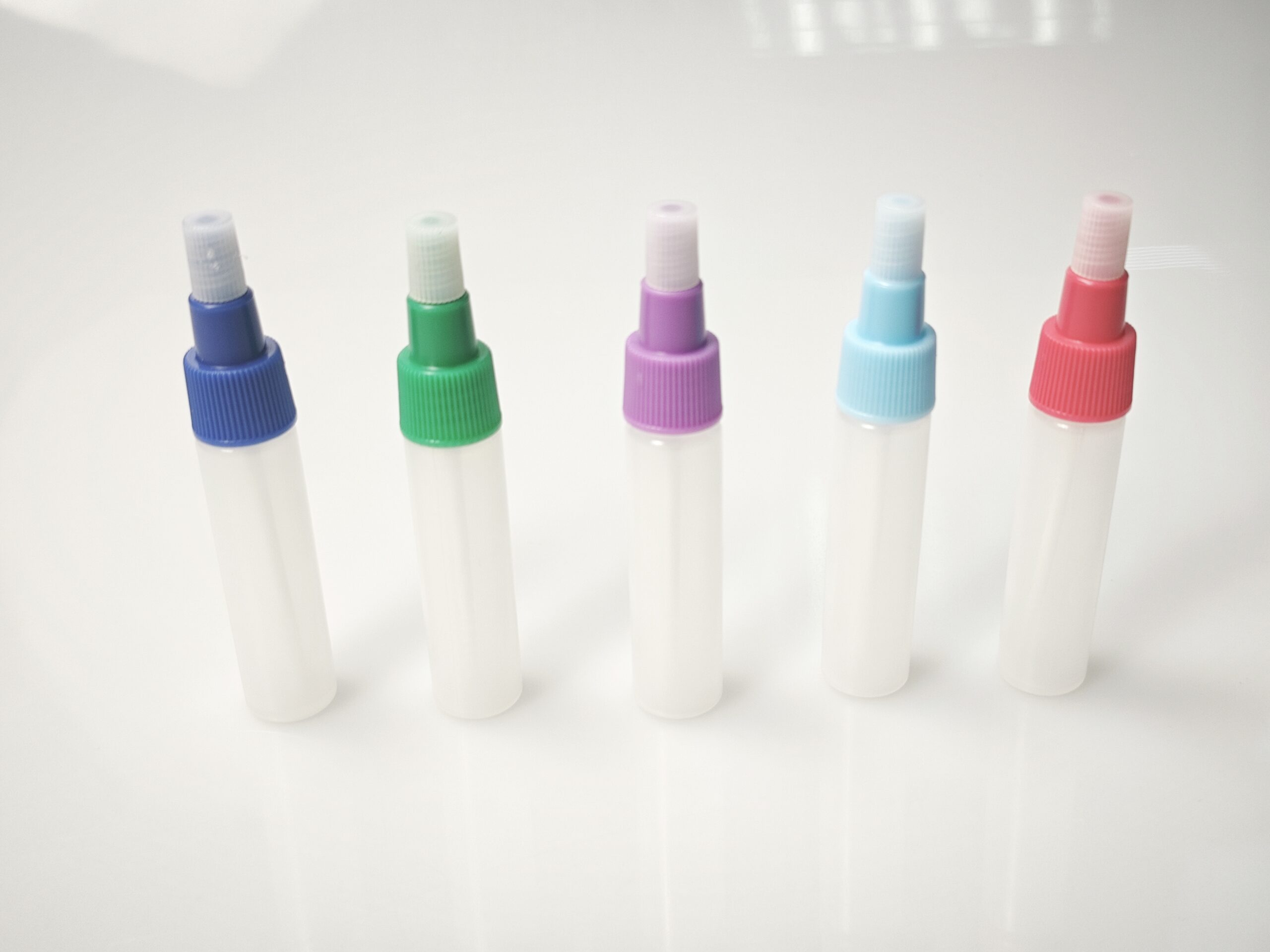
Color coding for multi-day protocols. Some FIT programs require samples from two or three consecutive bowel movements, collected in separate bottles. Color-coded caps — the approach visible in multi-bottle kit configurations — let patients track which sample is which without reading labels. It’s a small design decision that significantly reduces multi-sample collection errors.
Leak-proof reliability. Patients are being asked to seal a biological sample and put it in an envelope or collection box. Concern about leakage during transport is a real psychological barrier. A bottle that demonstrably doesn’t leak — with a well-engineered gasket or seal design — removes this concern from the equation.
The kit manufacturer’s perspective
For companies building branded FOB screening kits — whether for national screening tenders, pharmacy distribution, or employer health programs — the collection bottle is part of the user experience they’re designing. A great instruction leaflet paired with a poorly designed bottle still produces a frustrating patient experience. The bottle needs to carry its weight.
This has practical implications for component sourcing. The bottle can’t be evaluated in isolation from the assay it feeds. Buffer compatibility with the downstream FIT analyzer, sample volume consistency, and hemoglobin stability during shipping need to be validated together. A supplier who can provide documentation on all of these — stability data, buffer compatibility reports, elution volume specifications — shortens the validation cycle significantly.
OEM flexibility also matters for kit manufacturers. Branded programs often need custom labeling, specific packaging formats for postal kits, or cap colors that match a visual system already defined by the program. A supplier who treats customization as standard rather than exceptional is easier to build a product around.
Where the market is heading
Stool-based colorectal cancer screening is growing, and it’s growing fastest in markets that are expanding their eligible screening age and moving programs into primary care and pharmacy settings. The US lowered its screening start age to 45 in 2021. Similar expansions are underway in several European markets.
More people eligible for screening means more kits distributed — and more pressure on return rates. Programs are increasingly using digital reminders, AI-driven outreach, and behavioral nudges to improve compliance. But all of those interventions still depend on a kit that patients can complete successfully when they actually open it.
Changfeng Medical’s FOB sampling bottles are designed with this in mind. Available in multiple cap colors to support multi-sample collection protocols, with a sealed probe system and stable collection buffer compatible with mainstream FIT analyzers. Produced under ISO 13485 with CE MDR certification, and available with OEM customization for labeled kit programs.
Contact Changfeng Medical for samples and documentation →
Also from Changfeng Medical: Nasal Swab · Double-tip Throat Swab · Urine Collection Products