
Throw Length and Notch Design in Fully Automatic Biopsy Needles: Matching Specifications to Tissue Type

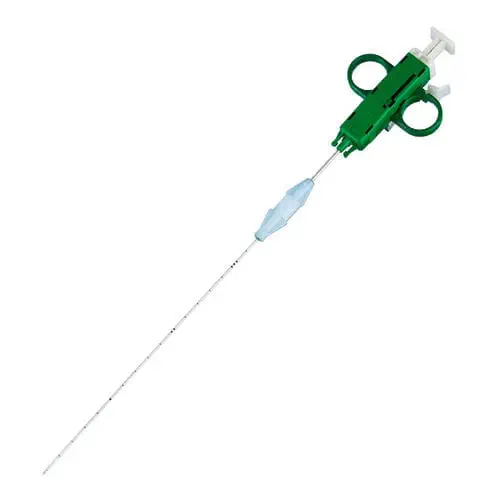
Two fully automatic biopsy needles can carry the same gauge marking and still behave very differently in the hands of a clinician, because gauge only describes the outer diameter of the needle. The variables that actually determine whether a device is suited to a breast lesion, a deep liver mass, or a small thyroid nodule are throw length and notch geometry, and these are the specifications that distributors and OEM buyers most often leave unexamined when comparing devices on a catalog sheet.
What Throw Length Actually Determines
Throw length is the total distance the needle assembly travels forward when fired, and it directly sets the length of tissue the device can sample in a single pass. Common throw options on fully automatic devices fall into two bands, roughly 18 to 20 mm and 22 to 25 mm, with some devices offering a selectable choice between the two before firing. A longer throw captures a longer core sample and can be advantageous for larger, well-defined lesions where sample volume supports a more confident pathology read. The same longer throw becomes a liability near small or irregularly shaped targets, where the extra travel distance increases the risk of the needle overshooting the lesion into adjacent healthy tissue or, worse, into a nearby vessel or organ capsule.
This is why dual-throw devices, which let the operator select the shorter or longer option immediately before firing based on real-time imaging of the lesion, have become a meaningful differentiator in product lines aimed at interventional radiology rather than single-purpose outpatient clinics. A distributor stocking only single-throw devices is effectively asking every clinic in their territory to standardize on one lesion-size assumption, which works for high-volume breast or prostate screening programs but is a poor fit for general interventional radiology departments handling a wider range of lesion sizes.
Notch Geometry and Sample Retention
The specimen notch is the recessed section of the inner stylet that the cutting cannula closes over to trap the tissue sample. Full notch exposure designs leave a longer, fully open channel for tissue to settle into before the cannula fires, which generally produces a more complete core but also a slightly higher risk of the sample shifting position during the brief delay between stylet advance and cannula closure in a fully automatic mechanism. Side-notch and reduced-exposure designs trade some sample length for better retention consistency, which matters more in softer or more friable tissue types such as liver or lymph node, where a fully exposed notch design is more prone to losing part of the sample on withdrawal.
Matching Specifications to Clinical Application
For breast and thyroid biopsy programs, a shorter throw in the 18 to 20 mm range paired with a standard notch design is generally the better default, since these procedures favor precision over maximum sample volume and the lesions are frequently small. For prostate and liver biopsy programs, where larger zones are being sampled and a longer core supports a more reliable histopathology result, the 22 to 25 mm throw range with full notch exposure is more commonly specified. Bone-adjacent soft tissue and lymph node biopsies tend to call for reduced-exposure notch designs regardless of throw length, prioritizing sample retention over raw core length given the friable nature of the tissue.
Specifying for a Multi-Specialty Product Line
Distributors serving multiple clinical specialties from a single biopsy needle line should resist the temptation to standardize on one throw and notch configuration for cost or inventory simplicity. A dual-throw device with a moderate notch exposure can cover a wider range of applications adequately, but it will rarely outperform a purpose-specified device in any single application. OEM buyers building private label kits for a defined customer base — a breast screening network, for example — are usually better served by a single, tightly specified configuration matched to that customer’s actual case mix than by a generalized device intended to serve every specialty at once.
Changfeng Medical manufactures fully automatic biopsy needles with configurable throw length and notch designs suited to breast, prostate, liver, and soft tissue applications, certified to ISO 13485 and CE standards. Contact us to discuss specification options for your clinical program or OEM kit.