
Coaxial Compatibility for Fully Automatic Biopsy Needles: Gauge Pairing Specifications OEM Buyers Need to Lock In

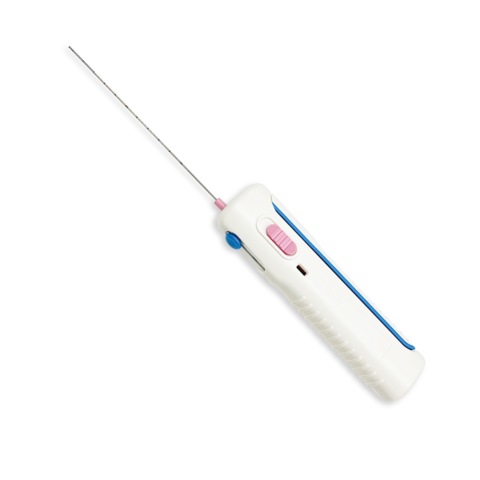
A fully automatic biopsy needle rarely works alone. In most percutaneous procedures it is paired with a coaxial introducer that establishes a single access channel, through which the biopsy needle is passed for repeated sampling without re-puncturing the patient. For OEM buyers assembling kits or distributors selling biopsy needles as a standalone line, the gauge relationship between the biopsy needle and its coaxial introducer is one of the most commonly mis-specified details in the entire procurement process, and it is not forgiving of guesswork.
Why the Gauge Gap Matters
The coaxial introducer’s inner diameter has to be large enough to let the biopsy needle pass through freely on every insertion and withdrawal, but not so large that the needle wobbles inside the cannula and loses targeting precision. Engineering data on this relationship generally points to an inner diameter to outer diameter ratio of at least 1.20 between the introducer and the biopsy needle, expressed in practical terms as the introducer being roughly two to three gauge steps larger than the biopsy needle itself. A typical pairing is an 18-gauge biopsy needle run through a 17-gauge thin-walled introducer, or a 20-gauge needle through an 18-gauge introducer. Pairing a needle with an introducer that is too close in gauge increases friction and risks tissue smearing on the way through; pairing it with an introducer that is too large undermines the entire purpose of using a coaxial system, since target accuracy depends on the needle being closely guided rather than free-floating.
Thin-Walled vs. Standard-Walled Introducers
Wall thickness on the introducer cannula is a second variable that buyers frequently overlook. A thin-walled introducer maintains a larger effective inner diameter at a given outer gauge, which allows a one-step larger gauge gap to perform as well as a standard-walled introducer with a smaller gap. This matters for kit cost control, because a thin-walled introducer can sometimes let a buyer specify one fewer distinct cannula size across a product line while preserving clearance, reducing the number of SKUs a distributor needs to carry to support a given biopsy needle range.
Throw Length and Cannula Clearance
The biopsy needle’s throw — how far the outer cutting cannula travels when fired — has to be accounted for in introducer length, not just diameter. If the introducer is too short relative to the needle’s total travel distance, the cutting cannula can fire past the end of the introducer tip during multiple consecutive samples, defeating the purpose of using a coaxial system to limit tissue trauma to a single tract. Buyers specifying a fully automatic biopsy needle for use with a coaxial introducer should confirm the needle’s fired length against the introducer’s working length, not just the unfired insertion length, since the two figures can differ by the full throw distance of the device.
Specification Checklist for OEM Orders
Before placing a production order for a biopsy needle intended for coaxial use, OEM buyers should confirm: biopsy needle gauge and total length including handle; fired length at maximum throw; intended introducer gauge and wall profile (standard or thin-walled); introducer working length relative to the needle’s fired length; and whether the kit will ship the introducer and biopsy needle under one product code or as separately ordered components. Buyers sourcing both components from the same manufacturer avoid the compatibility verification step entirely, since the gauge pairing and length tolerances are controlled within a single specification rather than reconciled across two suppliers’ tolerance ranges.
Changfeng Medical supplies fully automatic biopsy needles with coaxial-compatible gauge and length specifications under ISO 13485 and CE certification, including OEM customization for kit assembly. Contact us to request gauge pairing recommendations and a documentation package for your application.