OEM Blood Collection Tube Sourcing: Material, Closure, and Additive Variables That Affect Kit Validation

For IVD kit manufacturers, the blood collection tube is a component — not a standalone product. It’s validated as part of a system, and that means the tube supplier decision has direct consequences for regulatory submission timelines, re-validation costs, and production continuity. The variables that determine whether a tube works in a validated kit are more specific than most general purchasing criteria capture. Here’s a structured review of what to look at before committing to a supplier.
Tube Body Material
The shift from glass to plastic tubes is essentially complete in most markets — plastic now accounts for the majority of global production, driven by safety, breakage reduction, and logistics advantages. For OEM kit builders, the choice within plastics matters. PET (polyethylene terephthalate) offers good optical clarity for visual inspection and low gas permeability, which helps maintain vacuum in vacuum-draw formats. Polypropylene (PP) is more chemically inert and preferred where contact with aggressive assay reagents is possible. Some analytes — notably certain steroids and lipids — adsorb to tube walls at measurable levels; if your assay includes these targets, material selection should be confirmed with extraction recovery data.
Surface treatment of the tube interior also varies between suppliers. Some manufacturers apply silicone coatings to reduce cell adhesion and improve gel separator migration. If your kit relies on a clean cellular interface after centrifugation, the presence or absence of this coating is a parameter worth specifying explicitly rather than leaving to the supplier’s standard formulation.
Closure System
Closure performance has two relevant dimensions for kit integration: sealing reliability and penetration characteristics. For tubes used with automated pipettors or robotic sample handlers, the closure needs to be penetrable by the instrument’s probe at a consistent force — too soft and the closure collapses under aspiration pressure; too hard and probe breakage or sample splash occurs. This specification is usually not listed on standard data sheets and needs to be requested directly from the manufacturer.
For kits shipped directly to end users, particularly in home-based testing programs, closure re-seal performance after initial opening matters. A closure that doesn’t reseal reliably after the first use creates biosafety risk and sample loss at the user end. This is typically tested by measuring closure-open force before and after one penetration cycle.
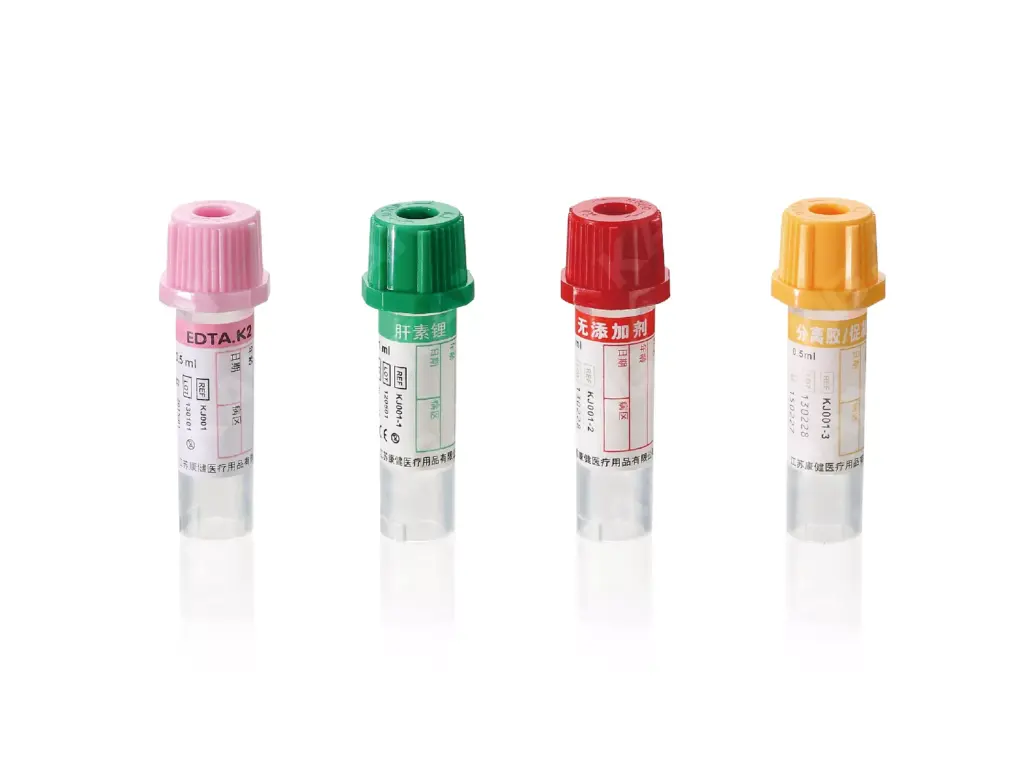
Color coding of closures is a secondary but practical consideration. International color coding conventions for tube additives (purple/lavender for EDTA, green for heparin, blue for citrate, red or gold for serum) are widely understood by clinical staff. Kits that use non-standard closure colors create training overhead and error risk in multi-tube collection scenarios.
Additive Specification and Documentation
Additive type and target concentration should be explicit in your component specification. The supplier should be able to provide: additive chemical identity and grade; target concentration per tube at nominal fill volume; acceptable fill volume range; and lot-to-lot QC data showing additive concentration consistency. This last point is particularly important in micro-volume formats, where the additive-to-blood ratio is sensitive to small absolute variations.
If you are developing a multiplex assay panel that requires the same blood draw to supply samples for multiple tube types, you also need data on additive carryover — the effect of sequential tube fills on sample integrity. This is a standard concern in phlebotomy protocols but is often overlooked when designing home-collection kits where the collection sequence is less controlled.
Regulatory Documentation Requirements
Blood collection tubes are regulated as medical devices in most markets. For kit developers incorporating them as components, the minimum documentation expected during regulatory review typically includes: ISO 13485 certification for the manufacturer; CE marking or equivalent market authorization for the tube itself; biocompatibility testing data per ISO 10993; and sterility assurance documentation where applicable. If your target market requires specific country registration for the tube as a standalone device, confirm this with your regulatory team before finalizing supplier selection — some markets require in-country registration even for components.
MDSAP certification is increasingly requested by distributors supplying into North American, Brazilian, Australian, and Japanese markets simultaneously. A supplier holding MDSAP covers the quality system audit requirement across all four jurisdictions with a single certificate, which simplifies your supplier qualification documentation significantly.
Supply Continuity and Change Notification
For regulated kits, any change to a validated component — including a change to the tube supplier’s raw material, manufacturing site, or process — may trigger a re-validation requirement on your side. Before finalizing a tube supplier, establish in writing what their change notification policy is and how much lead time you would receive before a manufacturing change takes effect. A minimum of 90 days’ advance notice is a reasonable expectation; anything shorter is a supply chain risk that should be reflected in your safety stock calculations.
Changfeng Medical holds ISO 13485 and MDSAP certifications and supplies single-use micro-volume blood collection tubes to OEM customers with full technical documentation packages. For sourcing inquiries and specification discussions, visit our blood collection tube product page or contact us directly.