Micro-Volume Blood Collection Tubes: What Additive Choice Actually Controls in Downstream Assays

Most procurement decisions for micro-volume blood collection tubes focus on capacity and compatibility with collection devices. That’s a reasonable starting point, but it misses the variable that causes the most downstream trouble: additive chemistry. The anticoagulant or separator inside the tube doesn’t just prevent clotting — it actively shapes what the analyzer sees. Getting this wrong at the sourcing stage means failed validations, re-runs, and in some cases, systematic bias in reported results.
The Three Main Additive Categories and What They Do
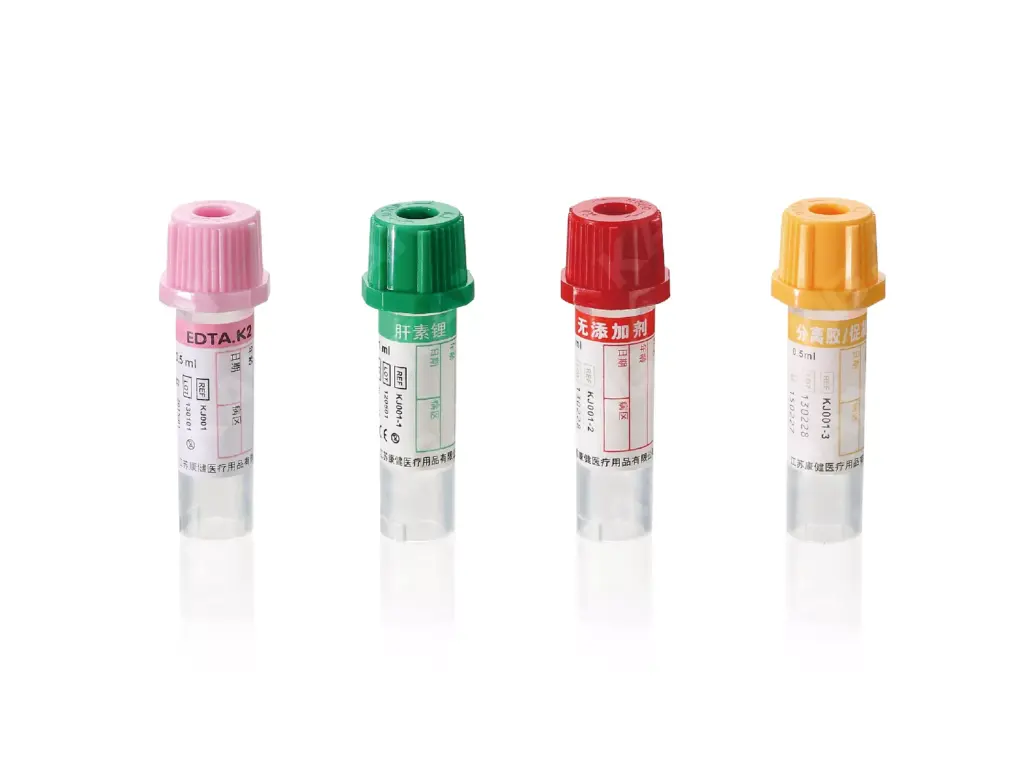
EDTA (ethylenediaminetetraacetic acid) is the standard for hematology panels. It chelates calcium ions, preventing coagulation without altering cell morphology when the concentration is correct. The critical variable is EDTA concentration relative to sample volume — too high causes cell shrinkage and falsely low MCV readings; too low allows micro-clots that block automated cell counters. For micro-volume tubes especially, where fill volumes may be 0.2–0.5 mL rather than 2–4 mL, this ratio needs to be precisely calibrated at the manufacturing stage and verified against the specific analyzer the lab is running.
Lithium heparin and sodium heparin tubes are used for plasma chemistry panels. Heparin activates antithrombin III and interferes with neither electrolyte readings nor most enzyme assays, which makes it the preferred anticoagulant when rapid turnaround is needed — plasma from heparin tubes is available faster than serum because there’s no clotting and retraction step. The tradeoff is that heparin interferes with PCR-based assays and some coagulation tests, so tube type can’t be treated as interchangeable across test menus.
Sodium citrate tubes at a 9:1 blood-to-citrate ratio are the standard for coagulation testing (PT, aPTT, fibrinogen). The ratio is fixed by international standards and is non-negotiable — under-filled citrate tubes produce falsely prolonged clotting times. In micro-volume formats where the fill line may be harder to observe, tubes with clear graduation markings and pre-metered citrate volumes reduce operator error substantially.
Separator Gel: When It Helps and When It Doesn’t
Gel separator tubes are designed to form a physical barrier between the cellular fraction and the serum or plasma after centrifugation, which extends sample stability and simplifies transport. For most routine chemistry panels this works well. Problems arise with certain analytes: some drugs, particularly some immunosuppressants and antiepileptics, are absorbed by the gel and produce falsely low results. Protein electrophoresis samples are also sensitive to gel contamination. Laboratories running these specific panels should either validate the exact gel formulation in use or route those specimens through non-gel tubes.
For kit manufacturers building multi-analyte panels, the gel question has to be resolved during assay development, not during purchasing. Switching gel formulations mid-validation is a common source of avoidable re-work.
Additive Stability and Lot-to-Lot Consistency
In micro-volume formats, additive concentration per tube is small in absolute terms, which means manufacturing precision matters more than in standard-volume tubes. A 5% variation in EDTA coating that might be acceptable in a 4 mL tube becomes significant in a 0.25 mL capillary tube. When evaluating suppliers, ask specifically about lot-to-lot coefficient of variation for additive concentration, and request QC data rather than just a certificate of conformance.
Changfeng Medical’s micro-volume blood collection tubes are manufactured under ISO 13485 quality management systems with documented additive concentration controls. Specifications and QC documentation are available for OEM buyers and kit developers on request.
Shelf Life and Storage Conditions
Additive stability over time is regulated by shelf life, but the conditions matter as much as the date. EDTA-coated tubes exposed to high humidity can see partial hydrolysis of the coating; citrate tubes stored at elevated temperatures may have concentration drift. For distributors holding stock in tropical or semi-tropical markets, this is a real consideration. Tubes should be specified with storage conditions tested at the relevant temperature range, not just at controlled 15–25°C conditions that apply in northern European or North American warehouse environments.
What to Request from Suppliers
Before finalizing a supplier for micro-volume blood collection tubes, the documentation you should have in hand: additive type, concentration, and target volume; lot-to-lot CV data for additive; compatibility data for the analyzers you’re running or the assays you’re developing; shelf life tested at relevant storage temperatures; and material safety data for the tube body and closure. If a supplier can’t provide this documentation readily, that’s information too.
The micro-volume blood collection tube market is growing steadily — demand for low-volume formats is rising in point-of-care testing and pediatric applications globally, and the specification complexity is rising with it. Sourcing decisions made purely on price and capacity will create problems later in the supply chain that are expensive to fix.
For product specifications and OEM inquiry, visit our micro-volume blood collection tube product page.