Home Testing Is Growing — and the Dropper Is Where User Error Happens

The at-home diagnostics market has expanded well beyond COVID-19. Consumers are now running lateral flow tests for influenza, RSV, strep, UTI, blood glucose, fertility, and drug-of-abuse screening — at home, without clinical training, and often under stress or urgency. That shift creates a specific problem for kit designers and manufacturers: the person operating the test is the weakest link in the sample delivery chain, and the dropper is the component that puts them in control.
What the research shows about user errors in self-testing
User errors in lateral flow self-testing cluster around a few consistent patterns. One of the most documented is incorrect sample volume — either too little sample added to the cassette well, or too much. Both produce misleading results. Too little can suppress signal development below the detection threshold; too much can flood the membrane and wash away the capture zone.
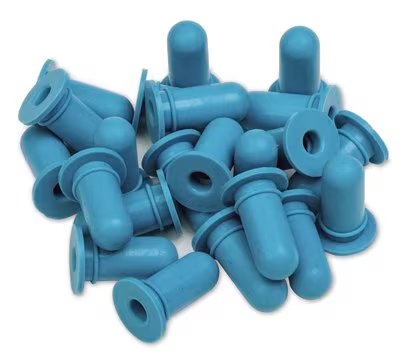
The dropper is the device that a non-clinical user picks up and squeezes without instruction beyond “add 3 drops.” Whether those 3 drops total 90 µL or 150 µL depends entirely on the dropper’s physical design. For most commodity-grade droppers, the answer is: it varies. Tip geometry, bulb stiffness, and orifice tolerance all contribute to that variation — and none of them are visible to the person holding the dropper.
The design factors that reduce user-introduced error
Kit developers who take dropper design seriously have moved toward a few specific engineering choices that reduce variability in untrained hands:
Self-limiting drop formation. A well-calibrated tapered tip allows a drop to form, reach critical mass, and detach without the user needing to judge when to stop squeezing. The surface tension of the liquid does the work. This only functions correctly when the tip diameter and taper angle are held to tight tolerances — which is a manufacturing quality question, not a design intention question.
Appropriate bulb stiffness. If the dropper body is too soft, grip pressure from a nervous or hurried user releases more liquid than intended. A body with medium stiffness — firm enough to require deliberate pressure, soft enough to release with a single squeeze — reduces the grip-to-volume variability across user populations.
Anti-drip tip design. Some dropper tips are designed with a slight taper that retains residual liquid inside the tip between squeezes rather than allowing it to dribble. For tests with multiple sample addition steps, this prevents contamination of the cassette rim between drops.
Ergonomic body length. Droppers that are too short are awkward to hold vertically, which matters because drop size changes with angle. A body length of 60–80 mm gives most users a stable grip and encourages a vertical hold naturally.
Regulatory expectations for home-use diagnostic kits
Regulatory agencies including the FDA and EU notified bodies evaluate home-use IVD kits with usability studies as part of the approval process. These studies specifically examine whether untrained lay users can successfully complete the test procedure, including the sample addition step. Failure modes identified in usability studies — such as “added too few drops” or “held dropper at angle” — can require design changes to the dropper before clearance is granted.
For kit manufacturers, this means the dropper is not just a procurement item. It’s part of the device’s human factors engineering documentation. Sourcing a dropper without volume consistency data, and then discovering the variability in a usability study, is an expensive sequence of events.
What this means for dropper sourcing decisions
The practical implication is that dropper selection for home-use kits should happen earlier in the development process, not as a late-stage purchasing decision. The dropper dimensions affect the volume delivery, which affects the assay performance data that goes into the regulatory submission. Changing the dropper after validation means re-running analytical studies.
For distributors assembling kits for home-use markets, the question to ask suppliers is whether they have drop volume characterization data — not just a nominal specification, but actual test data showing distribution across production lots. A supplier who can provide that data is operating at a different level than one who can only confirm “LDPE, medical grade.”
长丰医疗 (Changfeng Medical) manufactures straw droppers for IVD kit applications with documented dimensional control and material specifications. OEM format options are available for manufacturers with specific body length, color, or packaging requirements. Product details are available on the straw dropper page.
The home testing market is not slowing down. As kit volume grows and regulatory scrutiny of lay user performance increases, dropper design and consistency will become harder to treat as an afterthought. The best time to get the specification right is before the validation study, not after.