
Vacuum Blood Collection Tube OEM Customization: Six Specification Decisions That Affect Production, Compliance, and Shelf Life

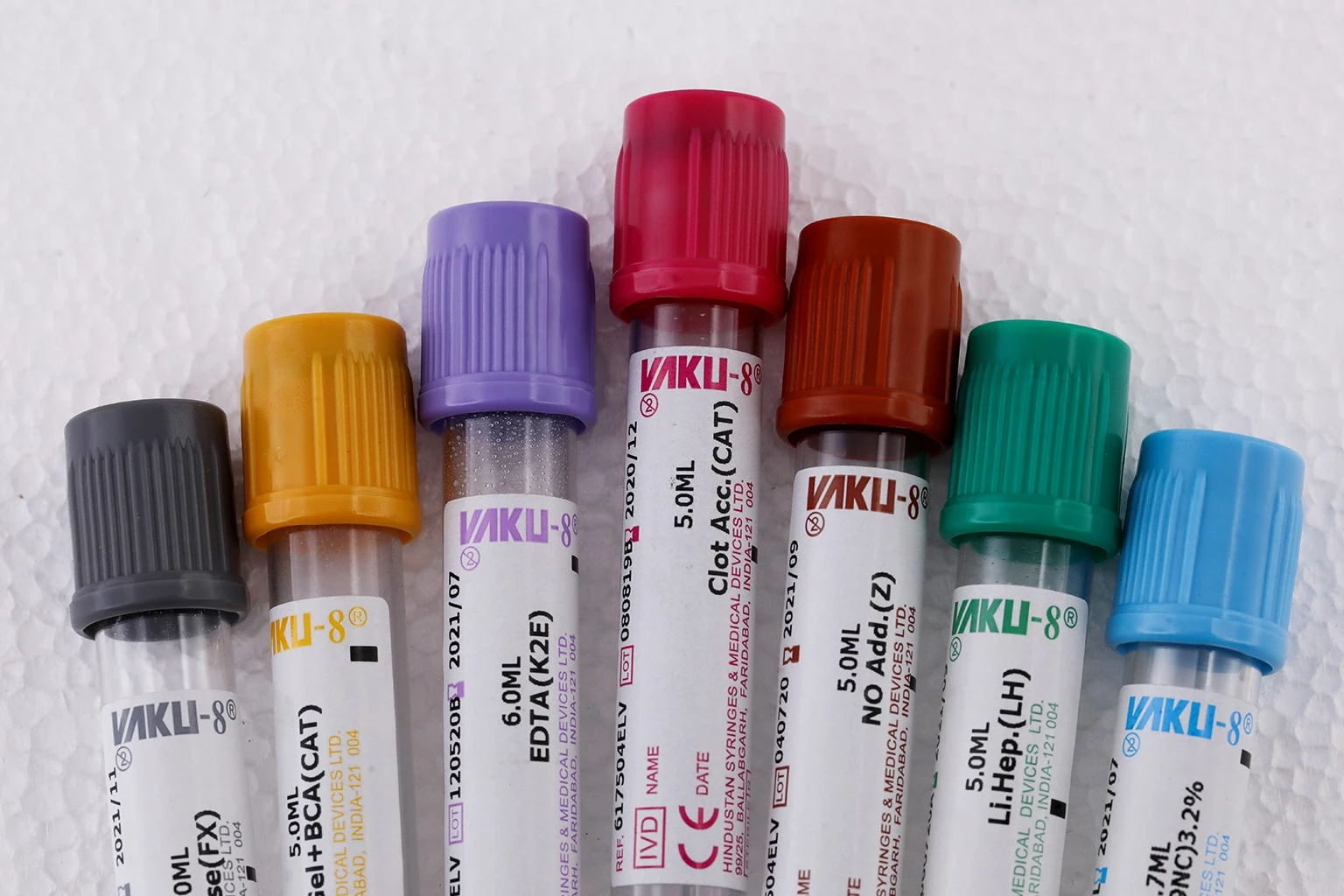
For a distributor or kit assembler sourcing vacuum blood collection tubes from a contract manufacturer, the tube is rarely the most complicated item in the kit — but it is consistently the one where specification ambiguity creates the most downstream problems. A tube that passes incoming inspection can still underperform in the field if the draw volume tolerance was not verified against the target analyzer, if the stopper formulation was not confirmed for compatibility with the assay chemistry, or if the stated shelf life was calculated at a different storage temperature than what your logistics chain provides.
The vacuum blood collection tube market is growing steadily, valued at around USD 4.36 billion in 2026 and projected to reach USD 6.23 billion by 2034 at a CAGR of approximately 4.6%. That growth reflects rising global diagnostic volumes, but it also means more manufacturers competing on price — which makes specification discipline on the buyer side more important, not less. Here are six decisions that every OEM customer should resolve before the first production order.
1. Tube Material: PET vs. Glass
Most modern blood collection tubes are made from polyethylene terephthalate (PET), which offers lower breakage rates during shipping and handling, lighter weight per unit, and easier disposal compared to glass. The trade-off is that PET has higher gas and moisture permeability than borosilicate glass, which affects vacuum stability over time. A well-manufactured PET tube with an appropriate wall thickness and stopper seal can maintain adequate vacuum for 12 to 24 months under controlled storage conditions, but this needs to be validated, not assumed.
Glass tubes remain the option of choice where extended shelf life is a hard requirement, where local regulations specify glass for certain sample types, or where the end user’s market has established glass as a procurement standard. For OEM buyers building kits for multiple target markets, confirm which material is required or preferred by region before setting tube specifications, as switching mid-contract is costly if the product is already registered with a specific tube type.
2. Draw Volume and Fill Tolerance
The nominal draw volume — 2 mL, 3 mL, 4 mL, 5 mL, 10 mL — is the easy part. What matters operationally is the fill tolerance: the range of actual collected volume that the tube’s internal vacuum will produce under normal venipuncture conditions. Industry practice accepts plus or minus 10% of nominal as a standard tolerance, but some high-sensitivity assay applications require tighter control, particularly for citrate tubes where the blood-to-anticoagulant ratio is clinically critical.
When evaluating a supplier, request fill volume data from their production QC rather than relying on the nominal specification alone. A supplier manufacturing at high volume should be able to provide distribution data — not just a pass/fail statement — showing that fill variation is centered and controlled. For micro-volume tubes used in pediatric or point-of-care applications, this is particularly important, as the absolute volume at play is small enough that even a 5% deviation can affect analyte concentration in a measurable way.
3. Additive Type and Concentration
Additive type should be specified by chemical name and form — not by cap color. For EDTA tubes, confirm K2 or K3, and whether the EDTA is spray-dried onto the tube wall or added as a liquid solution. Spray-dried EDTA provides more uniform distribution and dissolves rapidly upon blood contact; liquid EDTA has a slightly higher risk of incomplete mixing if inversion protocol is not followed. For heparin tubes, confirm lithium heparin vs. sodium heparin, and the coating weight per tube rather than just the nominal concentration, since the relationship between coating weight and effective anticoagulation depends on mixing dynamics.
For SST tubes, request the clot activator type (silica vs. thrombin) and the gel specification separately. Thrombin-based activators reduce clot formation time significantly — under five minutes vs. 20 to 30 minutes for silica — which matters for kits targeting emergency or stat testing workflows. Gel specific gravity should be specified as a range, with the centrifugation protocol for which it was validated stated explicitly.
4. Stopper Formulation and Needle Compatibility
The stopper serves two functions: maintaining the vacuum seal before use, and allowing needle penetration during draw without fragmentation or coring. Most modern stoppers are formulated from bromobutyl or chlorobutyl rubber rather than natural rubber, which reduces hemolysis risk and minimizes additive leaching into the sample. Confirm the stopper material with the manufacturer and request data on coring resistance — the stopper should not shed rubber particles into the tube when pierced by the standard needle gauge your kit includes.
If your kit is being assembled for sale in a market where a specific holder and needle system is dominant, confirm stopper geometry compatibility. Stopper diameter, penetration depth, and reseal characteristics vary between manufacturers, and a stopper optimized for one needle system may produce unreliable vacuum maintenance or coring with another.
5. Labeling and Regulatory Registration
Labeling requirements for blood collection tubes vary by target market. The EU MDR requires UDI on device labels, with the Unique Device Identifier structured according to GS1 or HIBCC standards. The FDA’s 21 CFR 801 requirements apply for US market products, and NMPA registration is required for products sold in China. If you are building a kit for multiple markets, the tube labeling — particularly the lot number format, expiry date format, and language requirements — needs to be resolved before artwork is finalized.
For OEM buyers reselling under their own brand, confirm whether the tube manufacturer can supply unlabeled or private-label tubes and what their minimum order quantity is for custom print runs. Some manufacturers require higher MOQs for custom color caps or non-standard label sizes, which can affect your kit cost structure at lower volumes.
6. Shelf Life Conditions and Cold Chain Requirements
Stated shelf life for vacuum blood collection tubes — typically 12 to 24 months — is always conditional on storage temperature and humidity. The standard is room temperature storage, usually defined as 4°C to 25°C, away from direct sunlight. Some additive formulations — particularly liquid anticoagulants or certain gel separator types — have narrower acceptable ranges or are sensitive to freeze-thaw cycling during transit.
If your distribution chain involves transit through high-temperature regions or uncontrolled warehouse environments, request real-time stability data at elevated temperatures from the manufacturer, not just the standard shelf life claim. Vacuum loss is the most common shelf life failure mode — a tube that has lost vacuum before use will underfill, producing a blood-to-additive ratio that is outside specification and results that cannot be trusted.
Changfeng Medical manufactures and supplies IVD diagnostic consumables including blood collection tubes for OEM and distribution customers across Europe, Southeast Asia, and the Middle East. Technical specifications, regulatory documentation, and custom packaging options are available on request through our IVD consumables product page.