Why Dropper Tip Accuracy Is a Make-or-Break Factor in POC Rapid Testing

Point-of-care testing has grown fast. The global IVD market was valued at over $106 billion in 2025 and is on track to exceed $128 billion by 2033. Much of that growth is being driven by lateral flow assays — the cassette-style rapid tests used for influenza, COVID-19, strep, pregnancy, and a widening list of other targets. What doesn’t get discussed nearly enough is the component that introduces the most variability in those results: the dropper tip.
The dropper is not a passive component
In a lateral flow rapid test, the sample dropper is responsible for delivering a fixed volume of specimen — typically diluted with buffer — to the cassette well. That volume determines how the sample flows across the nitrocellulose membrane, how analyte molecules interact with capture antibodies, and ultimately whether the result line reads clearly or not.
Research into lateral flow assay performance has consistently flagged dropper inconsistency as a root cause of user errors. When an untrained operator squeezes slightly too hard, tilts the dropper at an angle, or uses a tip with a poorly calibrated orifice, the delivered volume shifts. That shift — even by a few microliters — can produce a faint line that gets misread, or push the test into a zone where sensitivity drops below its validated threshold.
The irony is that a well-designed reagent kit can fail in the field not because the antibodies are poor, but because the dropper that ships with it is inconsistent.
What controls dropper volume output
Several physical factors determine how much liquid a dropper delivers per squeeze:
Orifice diameter. The tip opening controls drop size. A wider orifice produces a larger drop; a narrower one produces smaller, more variable drops as surface tension plays a bigger role. For most lateral flow applications, the target is a controlled drop of 30–50 µL. That requires tight tolerance on the tip bore — typically ±0.05 mm or better.
Wall thickness and bulb stiffness. The softness of the dropper body determines how much pressure is needed to expel a drop. If the plastic is too soft, minor grip differences between users translate into large volume differences. If it’s too rigid, users have to squeeze harder, which often results in multiple drops being expelled at once.
Tip geometry. A straight-cut tip behaves differently from a tapered one. A tapered tip focuses the drop to a point, which helps with consistent detachment and reduces the chance of the drop spreading across the cassette rim rather than entering the well cleanly.
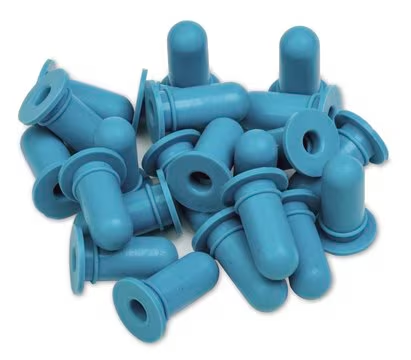
Material. LDPE (low-density polyethylene) is the standard for IVD droppers because it’s chemically inert, flexible, and compatible with buffer solutions. Variations in resin grade and processing can affect surface energy and how drops form and release.
Why this matters more now than it did five years ago
In a hospital laboratory, tests are run by trained staff using calibrated pipettes. Drop count doesn’t vary. In a pharmacy, a rural clinic, or a patient’s home, the person adding sample to the cassette may have never done it before. As rapid testing expands into decentralized settings — which is exactly where the market is heading — the human factors around sample delivery become more significant, not less.
Kit manufacturers assembling products for community health screening programs or consumer-facing self-test products are now asking harder questions about the droppers they source. They want to know the CV on drop volume across production lots. They want confirmation that the tip won’t clog when buffer solution contains surfactant. They want documentation that the material is compatible with heme-based samples without absorbing into the plastic.
What to verify when sourcing IVD droppers
For procurement teams and kit manufacturers, the following specs are worth confirming before committing to a dropper supplier:
Drop volume consistency. Request test data showing drop volume CV across a minimum of 30 units from multiple lots. A CV above 10% is a red flag for regulated POC applications.
Material certification. The dropper should be manufactured from medical-grade LDPE with documentation confirming no extractable or leachable substances that could interfere with antibody-antigen reactions.
Dimensional tolerances. Ask for engineering drawings with GD&T callouts, particularly on orifice diameter and tip length. These should be controlled by the mold, not by post-production sorting.
Sterility and packaging. For droppers used with human specimens, individual packaging in sealed pouches or bulk packaging under controlled conditions with documented microbial limits is standard.
Compatibility testing. If the dropper will be pre-filled with buffer at the kit assembly stage, confirm that the supplier has data on long-term storage compatibility — particularly whether the buffer composition affects the dropper tip over 12–24 months at ambient temperature.
OEM considerations
For kit manufacturers who want to differentiate on packaging or format, dropper customization is more accessible than many assume. Tip color, body length, and label printing can all be adapted without retooling the orifice geometry — meaning the critical performance dimension stays locked while the commercial format flexes.
Changfeng Medical supplies straw droppers and sample transfer components to IVD kit manufacturers and distributors, with OEM options available for volume orders. Specifications and sample requests can be submitted through the straw dropper product page.
As rapid testing continues its move out of the laboratory and into everyday settings, the components that govern sample delivery are going to receive more scrutiny — not less. Dropper consistency isn’t a secondary consideration. For any kit that depends on accurate lateral flow results, it’s a primary one.