Semi-Automatic vs. Fully Automatic Biopsy Needles: When Manual Control Still Wins

When buyers compare core biopsy needles, the conversation usually starts with gauge, length, and price. But there’s a more fundamental question that often gets skipped: do your end users actually need a fully automatic needle, or is a semi-automatic the better fit for the procedures they perform?
Both technologies have been on the market for decades. Both deliver diagnostic-quality tissue cores. The difference isn’t quality — it’s control. And depending on what your customers do day-to-day, that distinction can make or break a procurement decision.
How the Two Mechanisms Actually Differ
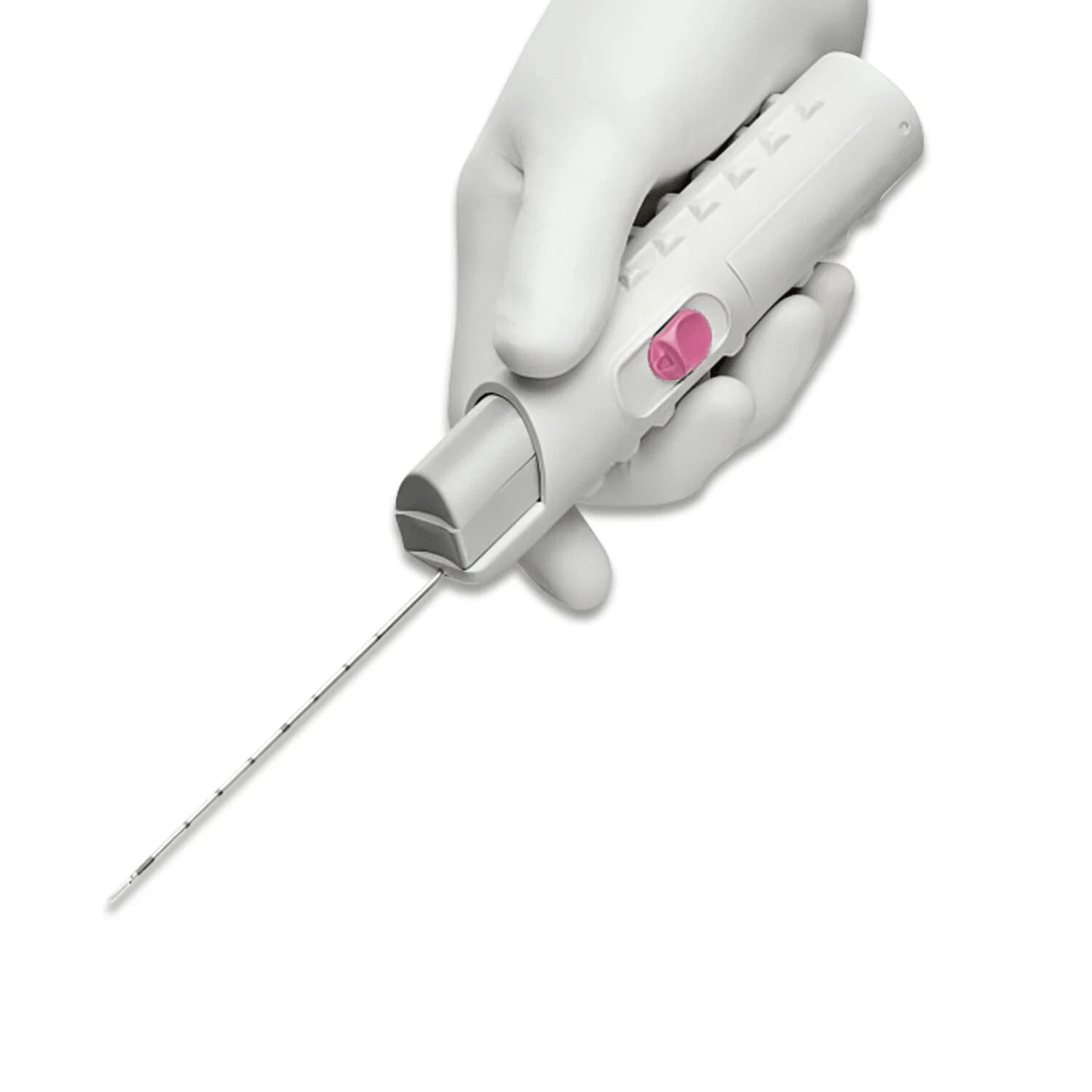
Fully automatic biopsy needles fire in a single motion. The operator positions the needle tip at the target, presses the trigger, and a spring-loaded mechanism advances the inner stylet (with its specimen notch) and the outer cannula in rapid succession. The whole cycle takes a fraction of a second — from “ready” to “specimen collected” in one shot.
Semi-automatic biopsy needles split that motion into two operator-controlled steps:
- The operator manually advances the inner stylet into the target lesion, exposing the specimen notch within the tissue.
- The operator then presses the trigger, and only the outer cannula fires forward — cutting and capturing the tissue sample.
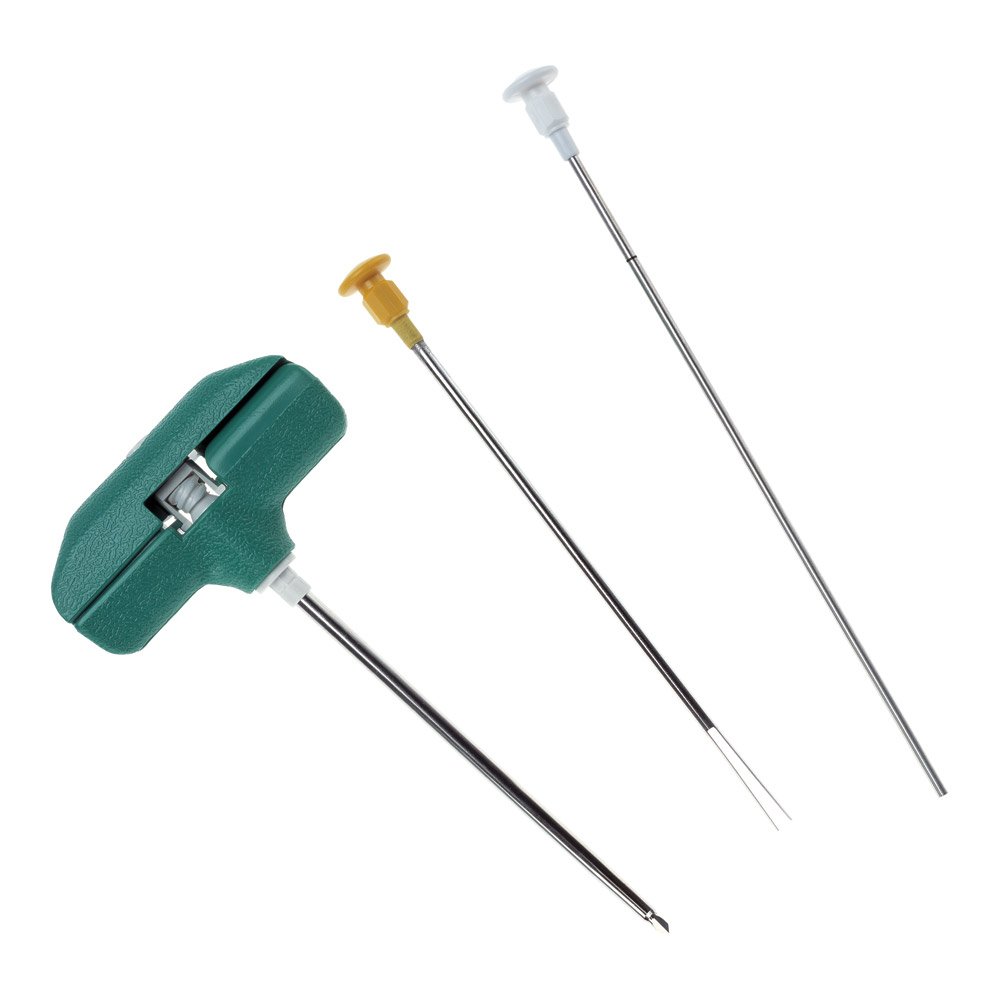
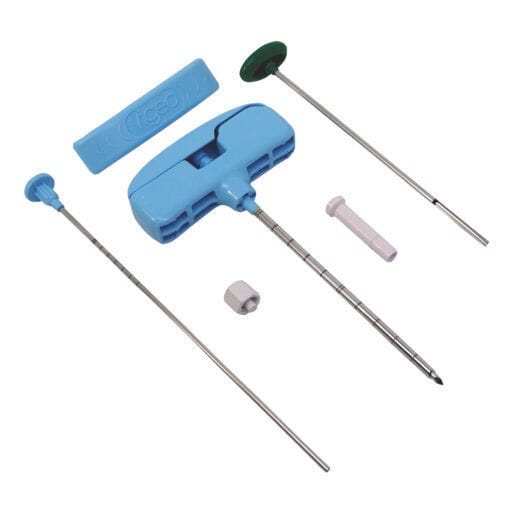
A typical semi-automatic design uses dual finger rings for stable single-hand operation, an exposed stylet with centimeter depth markings, and a triggerable outer cannula housed in a transparent body so the operator can verify the mechanism’s state at a glance. The clinician confirms the tip is exactly where they want it — under live imaging — before committing to the cut.
Why Clinicians Reach for Semi-Automatic
For interventional radiologists working under ultrasound, CT, or MRI guidance, the two-step mechanism solves several real problems:
Lesions near critical structures. When the target sits millimeters from a vessel, nerve, or pleural surface, the operator wants to confirm stylet position on the image before any spring-loaded motion happens. A fully automatic needle throws everything forward at once; a semi-automatic lets the radiologist freeze, verify, then trigger only the cutting cannula.
Small or deep lesions. Sub-centimeter lesions don’t leave much room for error. With a semi-automatic needle, the operator places the specimen notch exactly within the lesion under real-time imaging, then captures only what’s inside the notch. Hit rate on small targets is consistently higher with manual placement.
Mobile or irregular targets. Lesions that shift with respiration or sit in soft, displaceable tissue are easier to sample when the stylet can be guided in slowly, with the operator adjusting to the target rather than committing to a fixed firing throw.
Multiple cores from one entry. Once the stylet is positioned, the operator can fire the cannula, retract, rotate, and re-fire without fully repositioning the needle — useful when diagnostic yield demands several passes.
Fully automatic needles still dominate routine prostate, breast, and large-mass biopsies where firing speed and operator simplicity matter more than millimeter-level control. Both product types have a place in a well-stocked catalog. The mistake is treating them as interchangeable.
What to Look at When Sourcing
For distributors and kit manufacturers evaluating semi-automatic biopsy needle suppliers, several specification details matter more than headline gauge numbers:
Gauge and length range. Standard offerings are 14G, 16G, 18G, and 20G in lengths from 100 mm to 200 mm. Buyers serving deep-organ procedures (liver, kidney, lung) need the longer options; superficial biopsy customers focus on 100 mm and 150 mm. A supplier that offers the full range in a single platform simplifies your SKU management.
Specimen notch length. Common options are 10 mm, 15 mm, 19 mm, and 22 mm. Longer notches yield larger cores but require the lesion to accommodate the full notch depth. A supplier that offers multiple notch lengths within the same gauge gives end users flexibility for different lesion sizes.
Trigger force and consistency. The trigger should fire cleanly and at a predictable force, every time, across the full shelf life. Variation here is the most common complaint from clinical users — and the hardest defect to catch without proper batch testing. Ask for the supplier’s trigger-force test data, not just a specification claim.
Echogenicity. Surface treatments that improve ultrasound visibility — laser-etched markings, dimpled coatings — have become table stakes for ultrasound-guided products. Confirm the supplier can document echogenic performance with imaging tests, not just marketing claims.
Coaxial compatibility. Many procedures use a coaxial introducer needle paired with the biopsy needle. Suppliers offering matched coaxial sets reduce kitting complexity and validation work for distributors building procedure trays.
Visible depth markings. Centimeter markings on the cannula are essential for procedures performed without continuous real-time depth imaging. They’re easy to overlook on a spec sheet but heavily relied on in practice — especially by less experienced operators.
OEM and ODM Considerations
For brand owners sourcing semi-automatic biopsy needles for private label or bundled kit applications, the conversation extends beyond the needle itself:
- Packaging configuration. Single-needle pouches, kits with matched coaxial sets, or procedure-specific bundles each require different validation work upstream.
- Sterilization and shelf life. EO sterilization is standard; confirm the supplier’s validation supports the shelf life your regulatory filing claims.
- Regulatory documentation. CE-MDR technical files, FDA 510(k) references, ISO 13485 certificates, and MDSAP coverage should be available on request. Suppliers that have already cleared similar predicate devices accelerate your own submissions.
- Sample qualification timelines. Functional testing on biopsy needles — trigger force, core yield, dimensional accuracy, sharpness — takes weeks, not days. Build that into your sourcing schedule from the first conversation.
The Bottom Line
Semi-automatic biopsy needles aren’t a legacy product waiting to be replaced by fully automatic alternatives. They’re a parallel category, sized for procedures where manual control of the stylet matters more than firing speed. For distributors and kit assemblers, carrying both means you can serve the radiology suite that wants speed and the interventional team that wants precision — without forcing either to compromise.
If you’re evaluating semi-automatic biopsy needle suppliers, the right questions to ask aren’t about gauge alone. They’re about notch options, trigger consistency, echogenic performance, coaxial compatibility, and the supplier’s track record on regulatory documentation. Get those answers in writing, request sample units for hands-on testing, and the procurement decision becomes straightforward.
Changfeng Medical manufactures semi-automatic and fully automatic tissue biopsy needles under ISO 13485, with CE and MDSAP coverage. Gauge 14G–20G, lengths 100–200 mm, multiple specimen notch options, and coaxial-compatible sets available for OEM and ODM partners.