
FOB Sampling Bottles as OEM Components: What IVD Kit Manufacturers Need to Verify Before Committing to a Supplier

The global fecal occult blood testing market was valued at approximately USD 2.1 billion in 2024 and is projected to reach USD 3.5 billion by 2033, growing at a CAGR of around 6.5%. Much of that growth is being driven by expanding colorectal cancer screening programs across Europe, Asia Pacific, and Latin America — programs that run on standardized, high-volume consumables procured from component suppliers rather than assembled in-house by the test developer.
For IVD kit manufacturers building FIT or gFOBT products, the sampling bottle is not a commodity item. It is a functional component that directly affects sample integrity, assay performance, and regulatory compliance. Choosing the wrong supplier at this stage creates problems that are difficult and expensive to fix once the kit is validated and in production.
This article covers the technical and commercial factors that matter most when qualifying a FOB sampling bottle supplier for OEM use.
What the Sampling Bottle Actually Does
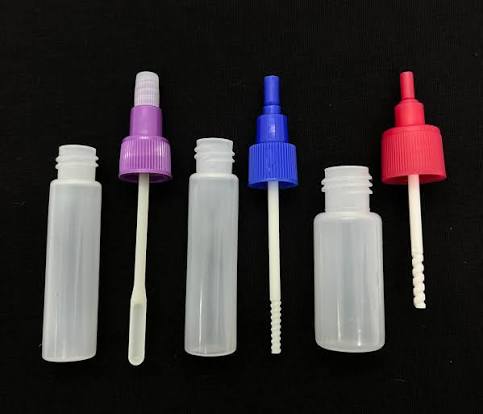
A FOB sampling bottle has three jobs: collect a reproducible stool sample, stabilize hemoglobin during transport and storage, and deliver a consistent sample volume to the analyzer or lateral flow cassette. Failure at any of these points affects test sensitivity and specificity — the two numbers that determine whether a screening program is clinically defensible.
The integrated sampling probe or spoon controls sample volume. If the probe geometry varies between production lots, the amount of fecal material transferred to the buffer also varies, and downstream hemoglobin concentration readings shift accordingly. For quantitative FIT analyzers, this is a calibration problem. For lateral flow formats, it can push weak-positive samples below the detection threshold.
The preservation buffer stabilizes hemoglobin during the interval between collection and analysis. Stability requirements differ depending on whether the program uses mail-in collection, same-day clinic submission, or cold-chain transport. A buffer validated for a 72-hour ambient transit may not be adequate for a rural screening program where samples sit at room temperature for five days before reaching a central lab.
Why Asia Pacific Suppliers Are Increasingly Competitive on This Component
Asia Pacific is now the fastest-growing region in colorectal cancer screening, driven by aging populations, rising colorectal cancer incidence, and government-funded screening rollouts in China, Japan, South Korea, and Australia. Chinese manufacturers that originally supplied domestic screening programs have scaled their production and quality systems to serve export markets, and many now hold ISO 13485 certification alongside CE marking for the European market.
The practical implication for kit developers is that Asia Pacific suppliers can offer lower unit costs on FOB sampling bottles without necessarily sacrificing the quality controls required for regulatory submissions. The key is knowing what to verify, since not every supplier that claims ISO 13485 has implemented the quality management requirements in a way that translates to consistent output at volume.
Technical Specifications to Lock Before Requesting Samples
Before contacting suppliers, kit developers should define the following parameters clearly, because the answers determine which suppliers can actually meet the requirement and which cannot.
Buffer volume and sample volume ratio. Most commercial FIT systems use a defined buffer-to-sample ratio to normalize hemoglobin concentration. If your assay was developed on a 2 mL buffer / 10 mg sample system and a supplier’s bottle delivers 3 mL buffer, re-validation is required. Confirm that the supplier can match your existing ratio or supply a new bottle format with documentation supporting the change.
Probe type and sample capture mechanism. Grooved probes, brush probes, and flat spoons collect different amounts of material from different stool consistencies. If your kit targets home users with no clinical training, the probe design affects compliance and collection reproducibility as much as it affects technical performance.
Buffer composition and hemoglobin stability data. Ask for stability data at the temperatures relevant to your distribution pathway — typically 2–8°C refrigerated, 15–25°C ambient, and a short-term elevated temperature excursion. Stability should be expressed as hemoglobin recovery percentage over time, not just a shelf-life claim. If the supplier cannot provide this data, they have not done the work.
Cap torque and leak resistance. Sampling bottles go into envelopes, bags, and parcels handled by postal services. UN 3373 packaging requirements for Biological Substance Category B apply to many colorectal screening programs. Confirm that the supplier has tested leak resistance under the applicable standard and can provide test records.
Available volumes. Standard commercial formats run from 3 mL to 10 mL total capacity. Larger volume bottles are used when multiple stool samples are collected from a single patient, or when the buffer is also used as a transport medium for molecular testing alongside immunochemical detection.
Regulatory Documentation the Supplier Should Be Able to Provide
The FOB sampling bottle is a component that goes into a regulated medical device. Your regulatory submission will reference the component, and auditors will expect evidence that the component supplier has been qualified. At minimum, the supplier should be able to provide the following without significant delay.
A current ISO 13485 certificate covering the scope that includes sampling bottles. Check the scope statement specifically — a certificate issued for reagent plates does not automatically cover sampling bottles if they are manufactured in a different process stream.
A Device Master Record or equivalent technical file for the bottle, including material specifications for the bottle body, cap, probe, and buffer. Material biocompatibility data referenced to ISO 10993 is required for components that contact biological samples, even when the contact is indirect.
Sterilization validation records if the bottle is supplied sterile. Most FOB sampling bottles are not sterile — they are clean but not sterilized — but some kit formats require sterile packaging. Clarify this requirement early and confirm that the supplier’s sterilization process and validation documentation match what your kit registration will claim.
Lot release testing records for a minimum of three recent production lots. Review the parameters tested and the acceptance criteria applied. If the supplier is testing only appearance and dimensional compliance but not functional parameters such as buffer pH or probe sample capture volume, that is a gap worth discussing before signing a supply agreement.
OEM and Private Label Considerations
Most kit developers do not want to co-brand their sampling bottle with the component supplier’s name. Confirm early whether the supplier offers blank or private-label packaging, and what the minimum order quantities are for custom labeling. For programs that operate across multiple countries with different language requirements, the ability to supply the same bottle in multiple label variants from a single source simplifies regulatory documentation and reduces the number of supplier qualifications required.
If you are building a kit that will be registered in both the EU under IVDR and in the US under 510(k) or De Novo pathways, confirm that the supplier can support both regulatory tracks. CE marking for the EU requires conformity with IVDR Annex I essential requirements as they apply to components. US submissions to FDA require documentation of supplier controls as part of the quality system record.
What to Watch for During Sample Evaluation
When evaluating samples from candidate suppliers, the functional tests that matter most are probe sample capture consistency across multiple collections, buffer hemoglobin recovery at the upper and lower ends of the clinically relevant concentration range, and cap seal integrity after a simulated transit stress. Appearance testing is secondary — a visually clean bottle that fails functional testing is not usable regardless of how it looks.
Run the samples against your existing validated assay system, not against an in-house reference method. The question you are answering is whether this bottle, from this supplier, performs consistently enough in your kit to support a regulatory claim. That question can only be answered in your assay system.
Changfeng Medical supplies FOB sampling bottles in 3 mL, 6 mL, and 10 mL formats with integrated sampling probes and preservation buffer. Bottles are available with custom labeling for OEM and private label programs. Documentation support for ISO 13485 supplier qualification and CE technical file requirements is available on request. Contact us for samples and specifications.