
Swab Packaging Formats: Individual Peel Pouches, Bulk Supply, and Kit Pre-Assembly — What Each Costs You Beyond Unit Price

Swab packaging decisions get made late in the procurement process, usually after tip material and shaft geometry are already specified. That sequencing underestimates how much the packaging format affects total cost, regulatory documentation requirements, and the operational realities of whoever handles the product downstream — whether that is a kit assembly line, a hospital storeroom, or an end user performing a self-test at home.
The three formats in common use for clinical and IVD diagnostic swabs are individually sealed peel pouches, bulk non-sterile supply for in-house sterilization or non-sterile applications, and pre-assembled kit configurations where the swab is packaged together with a transport tube, medium, and any other kit components. Each has a different cost structure, a different regulatory footprint, and a different fit for specific supply chain configurations.
Individual Sterile Peel Pouches
The peel pouch — a heat-sealed package combining a transparent film on one side and medical-grade paper or Tyvek on the other — is the standard packaging for individually sterile swabs destined for clinical use. The paper or Tyvek side is breathable, allowing ethylene oxide gas to penetrate for sterilization while maintaining a microbial barrier after sealing. The transparent film side allows visual inspection of the product without opening the package.
Individual pouches give distributors and end users clear product identity, expiration date visibility, and a sterile barrier that is easy to audit at the point of use. For hospital purchasing, individually packaged sterile swabs are often a procurement specification requirement — not just a preference — particularly for wound care, surgical site sampling, and other applications where sterility documentation accompanies the clinical record.
The regulatory requirement governing peel pouch packaging for sterile medical devices is ISO 11607, which specifies design, material selection, seal integrity, and shelf life validation requirements for sterile barrier systems. Under CE MDR, a swab manufacturer claiming sterility must have packaging validation per ISO 11607 as part of the technical file. This validation — which includes seal strength testing, dye penetration or bubble leak testing, and accelerated or real-time aging studies — is the documented basis for the labeled shelf life claim on the package.
Shelf life for individually pouched sterile swabs typically ranges from two to five years, depending on the material, sterilization method, and storage conditions. Accelerated aging studies (per ASTM F1980) allow manufacturers to establish claimed shelf life within a development timeline shorter than real-time aging. The acceleration factor assumes a specific storage temperature — usually 55°C for a Q10 factor of 2 — and the resulting shelf life claim must be confirmed by real-time data at the end of the accelerated study period.
For distributors importing individually pouched swabs, confirm that the shelf life on the product label is supported by packaging validation data per ISO 11607, not just by the manufacturer’s experience or convention. A labeled shelf life without underlying validation data is a regulatory gap that will surface in notified body review or FDA inspection.
Bulk Non-Sterile Supply
Bulk swabs supplied non-sterile — typically in bags or boxes of several hundred to several thousand units — serve applications where the sterile barrier requirement is different from clinical use. The two main use cases are: in-house sterilization by a kit assembler who purchases non-sterile components and sterilizes the finished kit as a unit; and non-sterile diagnostic applications such as certain molecular sample collection protocols where the sample itself is the source of biological material and environmental contamination of the swab is managed differently.
For kit assemblers using bulk non-sterile swabs as components in a kit that will be sterilized as a finished unit, the swab’s pre-sterilization bioburden is a critical input to the sterilization validation. ISO 11737-1 governs bioburden determination, and the swab manufacturer should provide bioburden monitoring data — pre-sterilization microbial counts per unit — as part of the incoming material specification. A bulk swab component with variable or undocumented bioburden creates uncertainty in the finished kit’s sterilization validation, particularly for gamma-validated kits where the sterilization dose is calculated from the component bioburden levels.
Bulk supply has a meaningful unit cost advantage over individually pouched product. The packaging material cost is lower, and the manufacturing process is faster without individual pouch feeding and sealing. For high-volume kit assembly operations where sterilization is performed on finished kits, bulk non-sterile swabs are often the right specification. The cost saving is real, and the regulatory responsibility — sterilization validation of the finished kit — sits with the assembler rather than with the swab manufacturer.
Pre-Assembled Kit Configurations
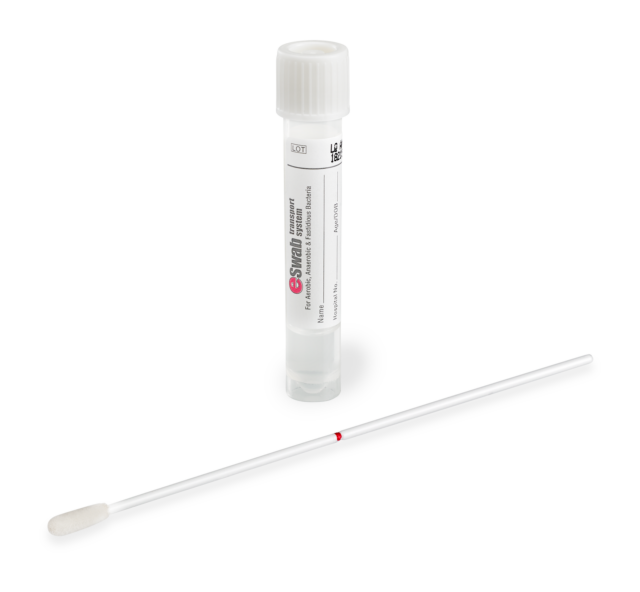
Pre-assembled kits — where the swab, transport tube, medium, and any ancillary items are packaged together as a finished collection kit — shift the assembly burden to the manufacturer and deliver a ready-to-use product to the end user. From the distributor’s perspective, a pre-assembled kit is a higher-margin, lower-handling product: there is no assembly step, no component sourcing from multiple suppliers, and no in-house sterilization to validate and manage.
The tradeoff is that the kit is a fixed configuration. Customization — changing the swab tip type, the medium volume, or the tube format to match a specific assay platform — requires going back to the manufacturer with a custom specification request, which adds lead time and minimum order quantity considerations. For distributors with a defined customer base and a known assay ecosystem, a pre-assembled kit from a single manufacturer that covers that ecosystem is efficient. For distributors serving a diverse customer base with multiple assay platforms, kit inflexibility can be a constraint.
Regulatory responsibility in pre-assembled kits also needs to be clear. If the kit manufacturer holds the CE declaration of conformity and the kit is sold under the manufacturer’s branding, the regulatory burden sits with the manufacturer. If the distributor white-labels the kit — sells it under their own brand — the distributor becomes the legal manufacturer for CE MDR purposes and is responsible for the technical file, including packaging validation, sterilization validation, and post-market surveillance. This distinction matters and should be negotiated explicitly in the supply agreement before products reach the market.
Choosing the Right Format
The decision framework is straightforward once the supply chain roles are clear. Individually pouched sterile swabs fit clinical distribution where sterility at point of use is required and the swab is sold as a standalone product. Bulk non-sterile swabs fit kit assembly operations with in-house sterilization capability and validated finished-kit processes. Pre-assembled kits fit distributors who want to deliver a complete, ready-to-use system to end users without managing component assembly themselves.
The format choice also affects inventory management. Individual pouches allow precise consumption tracking and reduce waste from partial-batch spoilage. Bulk supply requires careful first-in-first-out rotation and humidity-controlled storage to maintain product integrity before in-house sterilization. Pre-assembled kits have the most complex expiry management — the kit expiry is limited by the shortest-lived component, which is usually the transport medium rather than the swab itself.
Changfeng Medical’s sampling swabs are available in individually sterile peel pouch format and bulk configurations for OEM kit assembly. Packaging validation documentation per ISO 11607 is available for distributor and notified body review. Custom kit configurations and OEM labeling available on request.