
Evaluating a Blood Collection Tube Supplier: Quality Indicators, Documentation Requests, and Red Flags in the Qualification Process

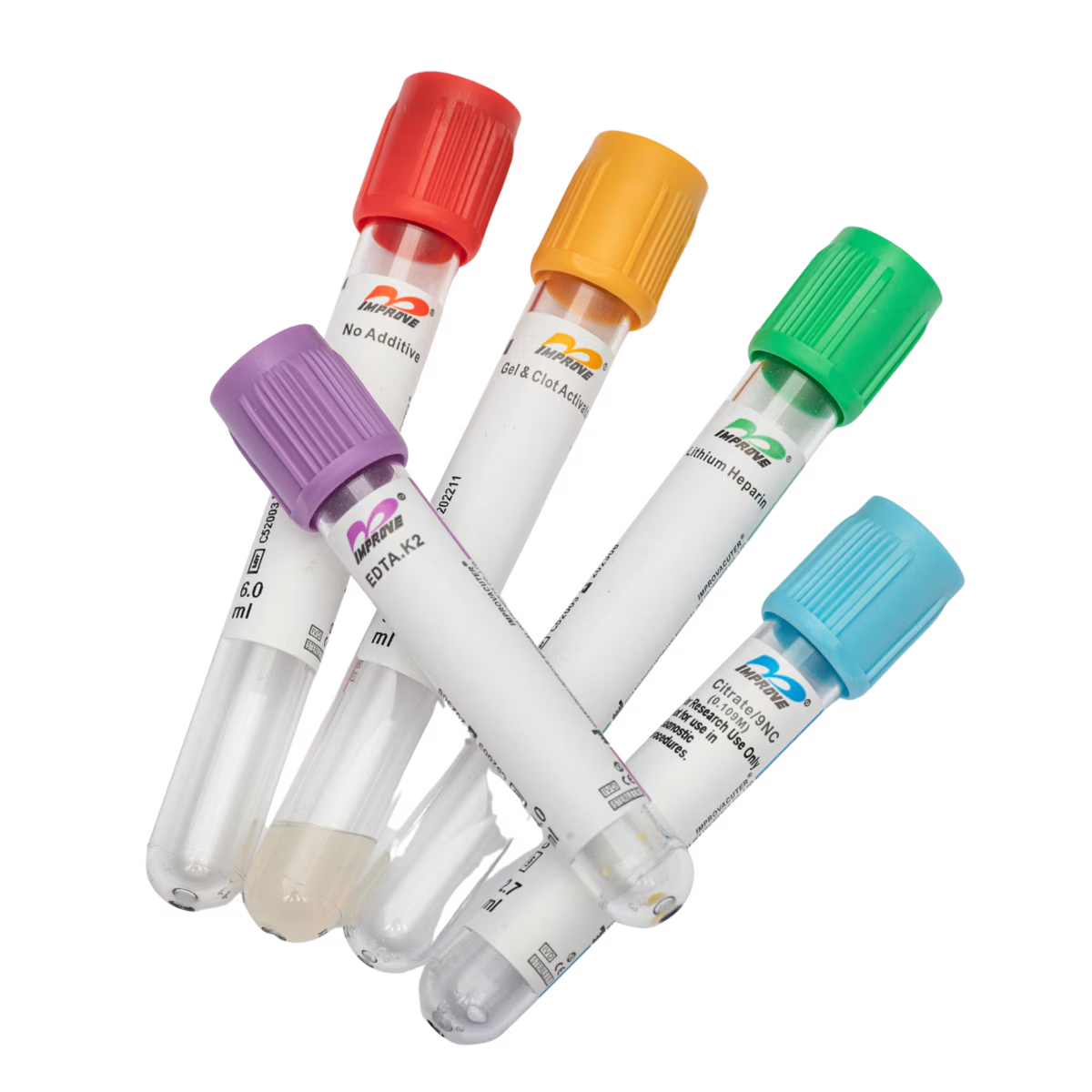
Qualifying a blood collection tube supplier is not a one-document exercise. The tube itself is a Class II medical device in most regulatory jurisdictions — or part of a kit that is — and the quality of the incoming component affects every downstream claim your finished kit makes about sample integrity, analyte stability, and diagnostic accuracy. A supplier who can produce a compliant CE certificate or ISO 13485 registration does not automatically have the process controls in place to deliver consistent product lot after lot at commercial volumes.
This article covers the documentation you should request, the manufacturing indicators worth evaluating during a supplier audit, and the patterns that typically signal quality risk before a contract is signed.
Start with Regulatory Registration, Not Just Certification
ISO 13485 certification tells you that a supplier has a quality management system in place. It does not tell you whether the specific product you are sourcing is registered as a medical device in the markets where you intend to sell it. Those are two separate questions, and confusing them is a common procurement error.
For CE-marked products, request the Declaration of Conformity along with the notified body certificate number and the name of the notified body. You can verify the certificate independently through the NANDO database. For FDA-registered products, the 510(k) clearance number should be searchable in the FDA’s public database. For markets where the tube will be used as an OEM component inside your kit — and where your kit will carry the registration — confirm with your regulatory counsel whether the tube supplier’s registration satisfies the applicable component documentation requirements in that jurisdiction.
Request a Product Technical File, Not Just a Datasheet
A product datasheet gives you nominal specifications. A technical file gives you the data behind them. The distinction matters because a supplier who has done the work — validation studies, stability testing, biocompatibility assessment per ISO 10993 — will have those documents available and will be willing to share relevant summaries. A supplier who is selling primarily on price and operating at the low end of compliance will often respond to technical file requests with marketing materials repackaged to look like specifications.
Key documents to request include: vacuum retention data over the stated shelf life, fill volume distribution data from production QC, additive concentration verification by lot, biocompatibility assessment for stopper and tube materials, and sterilization validation records for sterile products. You do not need full access to every internal procedure, but summaries and test reports for the above should be available to qualified OEM customers without requiring a signed NDA as a condition of initial qualification.
Evaluate the Manufacturing Environment
Blood collection tubes are not manufactured in a standard production environment. Additive coating — whether spray-dried EDTA, heparin, or clot activator — requires controlled temperature and humidity conditions to produce consistent coating weight and uniform distribution. Tube assembly, filling, and stoppering take place in a clean environment to control bioburden. Suppliers who cannot describe their manufacturing environment in specific terms — cleanroom classification, environmental monitoring program, in-process controls for additive dosing — may be producing product that meets specification on average but has unacceptable lot-to-lot variation.
If an on-site audit is possible, prioritize the additive dosing and tube-stoppering areas. Additive dosing is the step most directly linked to product performance; stoppering affects vacuum integrity and shelf life. For a remote audit, ask for recent internal audit findings and CAPA records related to these processes specifically, not just a summary statement that no major findings were observed.
Lot Consistency Is the Real Test
A supplier who can produce a compliant first sample is not necessarily a supplier who can maintain that quality at volume. Lot consistency — the ability to deliver product that performs within specification across consecutive production lots — is the quality characteristic most relevant to long-term procurement risk, and it is rarely visible in a one-time qualification sample.
Before awarding a contract, request historical lot release data covering at least six to twelve months of production for the specific SKU you are sourcing. The data should show fill volume, vacuum level, additive concentration, and any out-of-specification events with the associated CAPA disposition. A supplier with good lot consistency will share this data readily. A supplier who is reluctant, or who can only provide data for recent lots, warrants additional scrutiny.
Change Notification Obligations
Once your kit is registered with a specific tube component — stopper formulation, tube material, additive coating method — any supplier change to those characteristics may trigger a regulatory change notification or re-registration obligation on your side. This is a significant risk in sourcing relationships where the supplier has not committed to a formal change notification procedure.
The supply agreement should require the supplier to notify you in writing of any planned changes to materials, manufacturing process, or subcontractor sources within a defined period — typically 90 to 180 days — before implementation. This gives your regulatory team time to assess the impact before the change takes effect, rather than discovering it during an incoming inspection or, worse, from field complaints.
Red Flags to Watch For
Several patterns in supplier qualification processes reliably indicate elevated risk. A reluctance to share lot release data beyond the most recent production run suggests the supplier does not have historical data organized or does not want it reviewed. A certificate of conformance that states only “meets specification” without numeric values is not informative and signals weak QC documentation practices. Significantly lower pricing than comparable qualified suppliers — without a clear explanation tied to process efficiency or volume — often reflects a cost structure that cuts corners on incoming material inspection, environmental controls, or stability testing. And a supplier who cannot name the notified body that issued their CE certificate, or who cannot provide a NANDO verification path, may be operating on a certificate that is not current or not applicable to the product being sold.
Working with Established Suppliers
The blood collection tube market is supplied by a mix of global manufacturers and regional producers. Large players such as BD, Greiner Bio-One, and Sarstedt have deep regulatory portfolios and established quality systems, but their MOQs and pricing structures are not always suited to smaller OEM kit assemblers or regional distributors. Mid-tier manufacturers — particularly those based in China with ISO 13485, CE, and MDSAP certifications — can offer competitive pricing and shorter lead times, but require more thorough upfront qualification to confirm that their quality systems are genuinely functional rather than paper-only.
Changfeng Medical holds ISO 13485 and CE certification across its IVD consumable product lines. We supply blood collection tubes and related components to OEM and distribution customers and can support the qualification process with full technical documentation. Contact us through our IVD diagnostic consumables page for specifications and sample requests.